Showing posts with label cleanliness. Show all posts

Friday, June 21, 2013

How to care for yourself when you're ill

I don't care if you think you're Strong Like Bool -- sooner or later in life, you're going to come down with a case of the ick. Everyone does. When that day comes, don't be the person who has to call Mom or your significant other or whoever-it-is to come wait on you hand and foot because you have no clue how to take care of yourself. Unless you're seriously incapacitated -- as in hooked up to an IV drip in a hospital bed -- you can do most or all of these things on your own.

See a doctor.

Yep, start out with the advice of a specialist. You need to talk to someone with medical expertise who can review your symptoms, make an informed diagnosis and give you further instructions. And don't start in on me with "But I don't have health insurance!" (Situations like this are the reason you want health insurance in the first place, but that's a discussion for another day.) If you don't have a primary care provider, visit a walk-in health clinic. If you're a college student, there's usually a cheap or free clinic on campus. In a pinch -- say, when you have the shakes and a high fever (102 F or above) in the middle of the night -- get to an emergency room. The money you pay to care for yourself is an investment in the rest of your life, and some illnesses don't get better on their own, so don't mess around -- see a professional first.

Get and take any medication the doctor prescribes.

You're not going to need prescription medication for every illness, but on occasions when your doctor writes a prescription, pick it up from the drugstore right away. (If you're so far gone that you can't make it to the drugstore, call in a favor and get a friend to pick it up for you -- using your money, of course.) If you're concerned about what it's going to cost you, ask your doctor if there is a generic version of the medication available -- this usually lowers the cost of a particular drug -- and shop around if you can; prices for prescription drugs vary from store to store.

Most prescription medications now come with a long printed insert explaining how the medicine is used and what to expect from it. At the very least, read and know the serious side effects of any medicine you take; if you notice you're developing any of these side effects, or if anything else alarming happens -- for instance, if flaming snakes are erupting from your walls and ceiling, that's usually a bad sign -- stop taking the medicine and call the doctor who prescribed it right away.

If you don't get any serious side effects, you should keep taking the medicine as your doctor prescribed. Come on, you're not going to get better by magical medical osmosis if you pick up your prescription but don't actually take it. It's especially important to take antibiotics on schedule until they're all gone, not just until you feel better. Bacteria are tough little buggers, and some of them can bounce back and make you even sicker if you don't finish the whole course of antibiotics, so stick to the program.

Just have a cold? Some over-the-counter remedies are your friends. Others, not s'much. The FDA has more useful info.

Follow doctor's orders.

If your doctor recommends that you breathe moist air, get or borrow a humidifier and use it. If your doctor tells you to stay away from spicy food, put down the three-alarm chili. You just paid to get the benefit of six to eight years of medical school knowledge -- so follow your doctor's advice!

Let people know you're sick.

If people are depending on you and you're not going to be there, call or email them and let them know you're lying flat in bed with a case of the crud. As Wilford Brimley would say, "It's the right thing to do!"

Keep it clean.

You probably got sick because you were exposed to somebody with the mung in the first place. The best way to keep from spreading the joy around is to keep yourself and your environment clean. Also, you can combat some kinds of illness by reducing the total bacterial load. Bathe regularly, wash your hands, and if you're Super OCD you can get some of those antibacterial wipes and rub down things like door handles.

SLEEEEEEEP.

The human body is capable of healing itself, given some downtime, so get as much sleep as you can. Or at least get plenty of rest. If you can't just lie in bed without going stir crazy, watch a movie or play a game on your phone or just read a favorite book -- any pastime that doesn't require a lot of strenuous physical or mental activity is fine. If you have bronchitis or some other respiratory crud and find the coughing gets worse when you're horizontal, stick some pillows behind you to prop up your upper body. But stay down.

Force fluids.

Dehydration is a common side effect of many illnesses. Clean, potable water is the cheapest and best drink of all when you're sick, but you can also switch it up with apple juice, warm broth, ginger or peppermint tea, or the magical stuff known to mankind as chicken soup. (We keep a can of Campbell's Chicken and Stars soup in our pantry on the off chance someone in our household gets sick. The stars have magical healing properties! Ask my husband!) Just keep ladling it in. Yep, that means you're gonna need to pee a lot. It's all part of the process of flushing out the system.

By the way, yes, I know some alcoholic beverages are technically clear fluids, but they're NOT your friend when you're sick. Alcohol might help you sleep, but it also causes severe dehydration, which is the precise opposite of what you want. And that brings us to the next topic:

YOU AREN'T "SICK" IF YOU HAVE A HANGOVER.

Yeah, I know you probably feel like crap, but a hangover isn't an illness -- it's a consequence. You get ill because you were accidentally exposed to a virus or bacterium. There's nothing accidental about you being exposed to a fifth of Chivas Regal. And your boss probably didn't get where she is by being stupid. If she notices you're constantly calling in "sick" on Monday morning or the day after a long weekend, it won't take very long for her to see a pattern -- and for you to get canned. And frankly, you'll deserve what you get. Play it safe and don't drink the night before you go in to work. Doi.

While hangovers aren't an illness, alcoholism is. Think you might have a drinking problem? Adults aren't afraid to ask for help when they need it. Go get 'em, Tiger. Your loved ones (and your liver) will thank you.

Extra credit: get vaccinated.

If you're sick because of a highly-transmissible illness for which a vaccine exists, don't do the dumb again. Assuming you're not immunocompromised, make sure you're vaccinated against these diseases on whatever schedule your doctor or pharmacist recommends. You'll greatly reduce the chance of getting super sick or even dying from something you didn't have to suffer with in the first place. That's not just smart and healthy, it's frugal as well. Bonus!

Thursday, June 13, 2013

How to iron a shirt

There are several ways to handle a good dress shirt, but if you want to look really sharp and professional, you're going to have to learn how to iron that sucker. I could go through the steps one by one here, but a) I've got more important stuff to do today and b) it's really one of those things that's easier to learn by visual example. So I'm turning it over to a video how-to expert.

Here's one after my own heart:


Or if that isn't your style, you can just scan YouTube for your favorite tutorial instead.

A couple of random observations to aid you in your task:
  • Make sure the sole plate of your iron (the hot part that touches the shirt) is clean before you heat it up. If there's any gunk stuck to it, it will probably end up on your shirt.
  • Don't overheat the iron in the hope that it will make ironing faster. You could end up burning or melting your shirt this way, which just makes you look incompetent.
  • For fine fabrics, get a press cloth of woven 100% cotton and put it between the shirt and the iron as you press it. This takes a little while longer, but it keeps the shirt looking nice.
  • Don't iron over buttons. Many are made of plastic. Plastic + hot iron = dead button. Iron carefully around them instead, or grab a stainless steel teaspoon and put the bowl of the spoon upside down over the button as a heat shield while you iron around it.
  • Use your ironing time as a chance to check the shirt for any damage. If there's a stain, spot-treat it and wash it again. If a button is coming loose, sew it back on.
  • UNPLUG YOUR IRON WHEN YOU'RE DONE. I have a terrible habit of leaving the iron on, and when the time came to replace our old iron I ended up getting one that automatically shuts itself off after a few minutes of inactivity. Lifesaver, I tell you.

Monday, June 10, 2013

How to replace a toilet paper roll

Based on the plethora of anguished cries from spouses and significant others all over the planet, I've deduced that knowing how to replace a toilet paper roll properly is a) a sure sign of adulthood and b) in danger of becoming arcane wisdom. Let's try to rectify that today, shall we?

Steady, folks. I know this one is gonna be a toughie. The good news is that once you've gotten the basics down, you can change toilet paper rolls in residential bathrooms all over North America (unless they've gotten their TP dispensers from IKEA or something. Curse you, IKEA, you and your wily weird Scandinavian TP dispensers!). Never again need you flail about helplessly in the restroom, waiting for someone -- anyone -- to come and restore the TP to full working order, for YOU SHALL HAVE SKILLS.

You will need:
  1. a spring-loaded type toilet paper dispenser with an empty toilet paper roll on it
  2. a new roll of toilet paper
  3. minimal manual dexterity
  4. about 30 seconds of your time
Relax. Take a few deep breaths. Remind yourself that others have done successfully what you're about to accomplish. If it helps you achieve a Zen-like state, be seated on the throne in lotus position and meditate upon the paradox of soft-yet-strong quilted paper.

When you're ready...

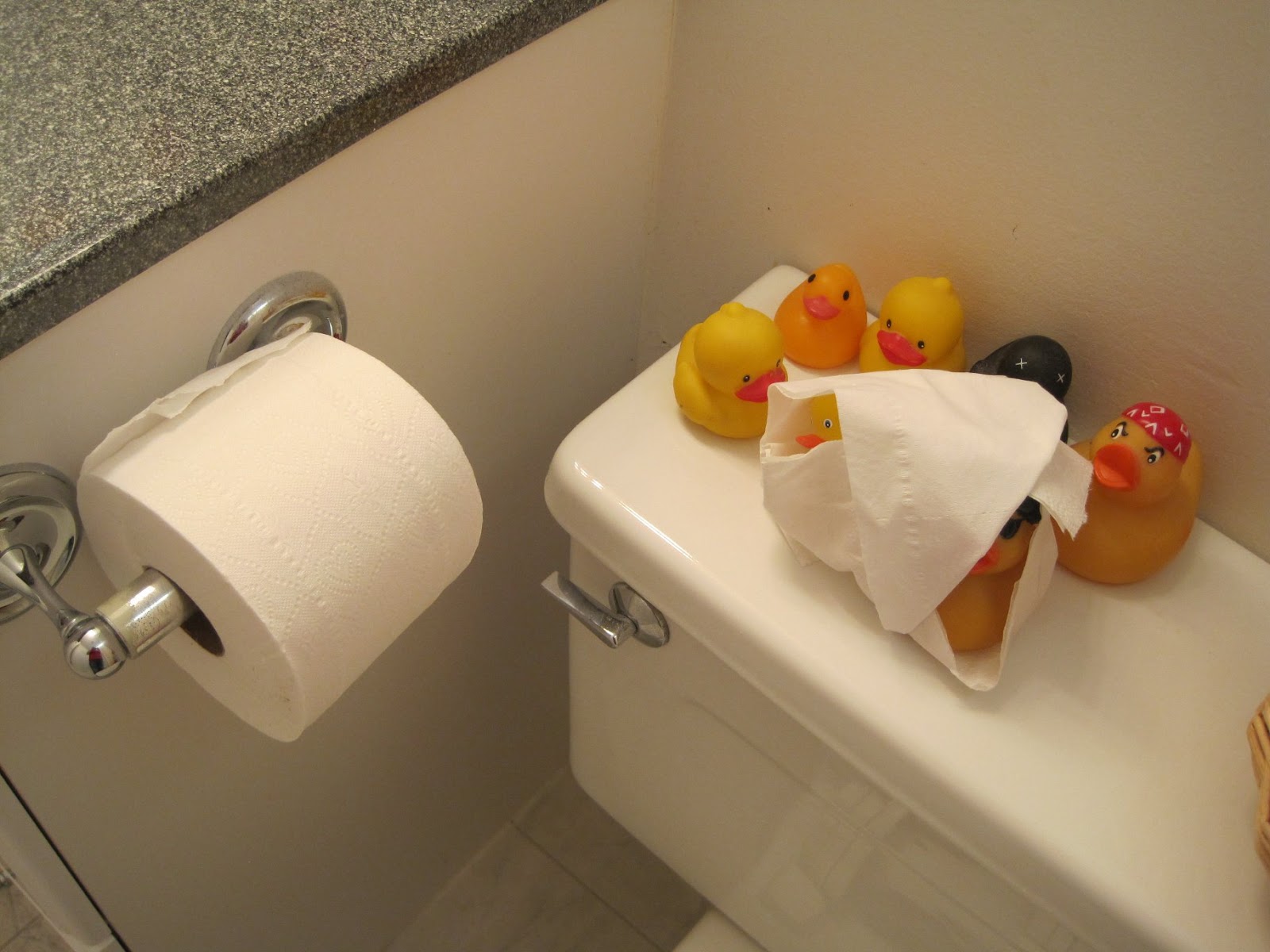
...turn to the task at hand. (Please ignore the ducks. They've invaded our bathroom and nothing we can do will dissuade them from hanging out atop the toilet tank.)

The bar across the center of this TP dispenser is spring-loaded. With boldness, grasp one end of the bar (it doesn't really matter which one -- just pick a side)...

...push firmly toward the other end, and guide the bar down and out of the brackets.

Assuming the spring-loaded bar didn't make a break for freedom and leap toward the floor, you now have a bar with an empty TP roll on it.

As the ducks look on in wonder, grab the empty roll and slide it off the bar. Houston, we have separation.

Once the empty roll is off, feel free to recycle it, craft it into some treasure of trash, or just fling it in the bin with utter insouciance. (Live for the moment, I say!)

Now pick up your trusty new roll of toilet paper...

... and slide the bar right through the handy-dandy hole in the middle.

The never-ending jihad known as Over or Under will not be discussed here. You figure out what works for your household and leave me out of it, OK?

Now you're going to perform a reverse version of the maneuver you used to get the bar off: fit one side of the bar into one bracket...

... press the bar in until it compresses a little...

... and guide the other end of the bar into the other bracket.

Mission accomplished! You now have a working roll of toilet paper, ready to go.

What you choose to do with it next is up to you.

Saturday, April 13, 2013

How to sew on a button

I'm not a sewing expert. Nonetheless, just as everyone who eats needs some basic cooking skills, everyone who isn't a nudist needs to master some simple skills in mending clothes. And here's the most common fix: sewing on a button that's come loose. I know -- how hard can it be to sew on a button? But as with so many other tasks, there's a right way and a wrong way to get it done.

There are two types of buttons you sew on: shank buttons and flat buttons. The shank button is smooth or rounded on top with no visible holes, and a loop on the underside (called a shank) through which you loop the thread to sew it to the garment. The flat button has two or four holes centered in the middle of the button; you use the holes to sew the button to the fabric.

Clearly I'm slumming it around here and should be wowing the professors in art school.
Whether or not they come with one built in, all buttons need shanks. Think of the shank as "breathing room" between the button and the fabric it's sewn to, enough space to allow the buttonhole to fit easily around the button. If you sew a flat button down too tightly, it won't hold the garment closed properly, or the button may tear the fabric or pop off from the stress (kind of like a college student's head during finals).

As it happens, my niece recently popped a button off her skirt, so I decided to kill two birds with one stone and document the whole process for posterity. Thanks to the talented Michele for taking some of these pictures, since I don't have three hands.

You will need:
  1. A few minutes' time.
  2. A matching flat button to be sewn on.
  3. A thin sewing needle (needles sold as "sharps" are good choices).
  4. Sewing thread.
  5. A shank spacer, such as a tapestry needle, toothpick or matchstick.
  6. Sharp scissors.
YES! Welcome to the wonderful world of PHOTOGRAPHY!
Start with a button that matches the others on the garment, if at all possible. If you're fortunate enough to have the original button that popped off (as I did), by all means use it. If it rolled away and is lost for good, first check along the inside seams of your garment; sometimes the manufacturer will sew on an extra button or two for mending purposes. If that fails, you can snag a button from somewhere else on your garment where it's unlikely to be noticed (at the lower hem of a skirt or a shirttail is usually a good place), sew that one on, and replace the less noticeable button with one that's close to the same color, shape and size. If you're ~=*!!!SUPER OCD MAN!!!*=~ and the idea of mismatched buttons anywhere on a garment drives you batty, you could remove ALL the buttons from the garment, buy a matching set of replacement buttons that are the same diameter as the originals, and sew them all on using this method. Or you could just follow your doctor's advice and take your meds.

Any loose threads still attached to your button? Trim them off before you begin. Nice and neat.

Thread your sewing needle with about 18 inches of thread in a matching color...

...and pull it through until the thread is doubled over on itself. You can tie a knot in the tail end if you want, but you really don't need to.

Give the garment a close look. You should be able to find the place where the button popped off (helpfully indicated by the blindingly white arrow here) -- it will have small, regularly spaced holes where the stitches used to be, or a rough spot in the fabric. If you can't find it, just button up the garment neatly and poke the needle through the empty buttonhole to find the right spot.

Time to secure the thread. Flip the garment over to the wrong side and, at the point where you're going to sew on the button, make two or three small stitches in the same space. If you didn't knot the thread, leave a thread "tail" a few inches long at the end of your first stitch, then hold these thread ends in place with your thumb so they don't slip out of the fabric as you take the second stitch.

After the third stitch, the thread should be nice and secure. Trim off the thread end "tail" fairly close to the stitching.

Poke the needle through to the right side of the fabric and draw the thread all the way through, preparing to sew on the button. Check the wrong side to make sure you haven't left a rat's nest of tangled thread back there. You may need to pull gently on one side or the other of the doubled thread to close up any thread loops on the wrong side.

Look at the other buttons on the garment to see how they're aligned. The buttons on this particular skirt are vertically aligned, with stitching running from the top to the bottom holes.

So align your button the same way, in just the spot where you want it to be.

Poke the needle through the top hole of the button and draw the thread through.

Before you do anything else, grab your shank spacer and place it between the two button holes as shown. I used a big ol' tapestry needle because it happened to be in reach and its smooth metal surface makes it easy to remove, but I could have used a matchstick or a toothpick or even a super-small knitting needle. You'll have to hold the spacer in place with your non-dominant hand while you sew with the other one.

Poke the needle through the bottom hole to the wrong side of the fabric, and draw the thread all the way through, looping it over the shank spacer and pulling it taut. First stitch made.

Repeat this process several times -- poking the needle up through the top hole, drawing the thread through, looping it around the shank spacer and down through the bottom hole -- until you've got a good number of stitches in place. Pull gently on the sewing thread as needed to make sure you aren't leaving loose, messy loops of thread on either side of the fabric. Since your thread is doubled, it shouldn't take very long until you've got a nice solid loop of threads, like this.

Now pretend you're Arthur with the sword in the stone and, with one bold move, pull out your shank spacer. Tadaaa! You are rightwise king of England!

Next up: form the shank. Poke the needle through to the right side of the fabric (but NOT through a button hole) and draw the thread all the way through...

...then wrap the thread four or five times around the sewn threads underneath the button to complete the thread shank...

...and poke the needle back through the fabric at the same spot it came out, drawing the thread through and making sure it's nice and taut.

Back on the wrong side of the fabric, take a few small stitches to secure the thread...

...and take one more stitch, but before drawing the thread through completely, thread the needle through the thread loop and pull it tight to create a knot that's flush against the surface of the fabric. Then trim off the thread.

All done!

Fasten the new button to make sure it looks all right. Then air-guitar like a rock star at the awesomeness of your well-done job.

(Four-hole flat buttons work almost exactly the same way -- you just create an X with your threads, alternately sewing vertical and horizontal stitches over the shank spacer. And shank buttons just need to be sewn firmly down without any added spacing, since the shank is already built into the button.)

Wednesday, November 14, 2012

How to clean your bedroom

Dirty socks. Pizza boxes. Empty aluminum cans. Junk mail. Cereal bowls with the remains of mysterious starchy gunk welded to the bottom. And that's just the crap covering the top of the mattress. Face it, kid, your room is a sty. Nobody wants to live like this. You're gonna fix that right now.

This tutorial assumes you are just a slob, not a hoarder. If you're saving 238 used Dixie cups because you might need them some day, you need help way beyond what this post can offer. Counseling, and possibly some high-pressure hoses, may be in order.

You will need:
  1. An empty box.
  2. Enough time to tackle the mess (this will vary depending on how long it's been since you last cleaned and how sty-like your room has become).
  3. A clothes hamper.
  4. A small garbage can.
  5. A dust cloth (a basic rag is fine).
  6. A broom and dustpan.
  7. A vacuum cleaner (optional).
  8. Multipurpose surface cleaner (brands include Mr. Clean, 409, Method, etc.) and water to dilute, and/or pre-mixed spray cleaner.
  9. A step stool or sturdy chair (optional).
  10. A bucket (yes, you has a bucket).
  11. Window cleaner and paper towels (optional).
Drag your empty box into the room. Find every object in your room that's supposed to be somewhere else in the house or apartment, and put it in the box. Now put the box to one side, where you won't trip over it; you'll deal with its contents later.

Pick up everything else that's supposed to be in your room, and put it away where it belongs. Yes, that means the random stuff you've been stashing under the bed, doofus. Hang clean clothes in the closet, or fold them and put them in the dresser drawer. Put all dirty clothes in the hamper. Strip the sheets off the bed and put those in the hamper too. (If you have been sleeping on a bed with no sheets because you can't be bothered to make your bed, I'MA COME OVER THERE AND SLUG YOU.) Grab a small garbage can and toss out any junk you've been accidentally saving for posterity. If something is lying on the floor or piled up on your dresser because you don't have a designated spot for it, it's high time you came up with one. Otherwise it goes in the garbage can. When you're done you may have to go out and pick up some storage containers for your stuff, BUT NOT NOW. Right now you are cleaning your room and NOTHING SHALL DISSUADE YOU!

Once all the random crap has been picked up, it's time to start cleaning in earnest. You can clean your room most efficiently from top to bottom. First, look up. You probably have long, dusty cobwebs hanging from your walls and ceiling. Even if you can't see them, drape your dust cloth over the bristles of the broom and sweep it around the ceiling perimeter. You can also dust any overhead light fixtures, but be gentle. I don't want to see the headline "Clueless Noob Brained By Falling Ceiling Fan" on Google News any time soon.

Pull the dust cloth off the broom and dust every horizontal surface in the room -- windowsills, bookshelves, dresser top, bedside tables. You don't need dusting spray to do this, although it helps. If you can wet down the dust cloth a bit, then wring it out until it's just barely damp, it will pick up a lot of dust without leaving surfaces sloppy wet. Depending on how much dust, cobwebs and dead bugs you're picking up (gleah), you may have to rinse and wring multiple times.

If you have a window (and let's hope you do), grab the window cleaner and paper towels. Spray down the window, give it about 30 seconds for the cleaner to do its work, then wipe off with paper towels. Don't use multipurpose cleaner on windows unless the cleaner specifies that it's safe for glass (you can permanently fog up your windows if you guess wrong). Put the used paper towels in the garbage.

Inspect your walls. Do they have scuff marks, stains, or traceries of any mysterious gunk? Yech. Pull out the multipurpose cleaner and, if necessary, mix up a batch in the bucket, diluting it with the recommended amount of hot water. Or just use a pre-mixed spray cleaner. Use your dust cloth and multipurpose cleaner to wipe down the walls. If you're a stunted little dwarf like me or have high ceilings, you might need a step stool or chair to reach the highest part of the wall.

Make the bed with clean sheets and pillowcases. Check the cleanliness of your blankets while you're at it. Blankets don't need to be cleaned as often as sheets, AS LONG AS YOU ACTUALLY USE THE SHEETS, you slobtastic wonder, you. If the blankets need cleaning, put them into your hamper.

You're into the home stretch. Take the step stool, garbage can, clothes hamper and box fulla stuff and remove them from the bedroom.

Now look down at your floor. (Didn't know you had one, didja? Surprise!) In North America, you'll probably be looking at one of three options: 1) a bare floor of some kind, 2) a bare floor covered by an area rug, or 3) wall-to-wall carpet.

For 1): use the broom and dustpan to sweep the whole floor. Yes, under the bed too, doofus. Sweep small sections at a time, load the dustpan, then empty it into the garbage can. Mix up another batch of multipurpose cleaner if the first batch is getting nasty, then use the cleaner and dust cloth to wash the floor. Alas, yes, on hands and knees this first time. Squeeze out the dust cloth until it's nearly dry, and the clean floor will dry much faster. (For future reference, stick mops are your friends.) Start at the wall furthest from the door, and work your way across the room (yes, under the bed too, doofus) until you wash right out the exit. If you're a complete wimp, you can slip track shoes or a foam pad under your knees to help cushion your tender patellas as you work.

For 2): if the area rug is small, take it outside and beat it with the broom. Think about an annoying teacher, abrasive celebrity or exasperating politician and vent your frustrations creatively. Bonus points for an aerobic workout! Then proceed to wash the bedroom floor as for 1). Once the floor is completely dry, return the rug to its proper place. If the rug is big, vacuum it, then wash the rest of the floor around it.

For 3): pull out the vacuum and thoroughly vacuum the carpet. Yes, under the bed too, doofus. The carpet may have marks or stains of unknown origin. You can try to spot-treat the carpet, rent a Rug Doctor and clean it, or hire professionals to take care of it (I recommend the last option for best results). Put the vacuum away.

Put away the step stool. Empty the garbage can. Tip the dirty multipurpose cleaner into the sink or tub to drain, and rinse out the bucket with clean water, then put it away. Empty the box fulla stuff by putting away the items in their proper places outside your room. (DO NOT CHEAT BY DUMPING IT ALL IN THE HALL CLOSET... the Fuse Box Dwarf is watching you, pal! Dreeb! Dreeb!) Wash and dry your bedsheets (and, if necessary, blankets; once they're clean, finish making the bed with them). Put away any remaining cleaning paraphernalia. Oh yeah, your room is CLEAN, baby.

Now, do you have to go through this rigamarole EVERY SINGLE TIME you clean your room? Thankfully, no. This is the thorough clean, once-a-week job, and unless you're a heavy smoker or something you don't need to wipe down the walls every week. This first time will probably be the worst. The daily-clean version of this job involves picking stuff up and making your bed, which is very doable. So do it.

WARNING: side effects of a really clean room include the realization that there's suddenly So. Much. Room. in there, possibly inspiring you to climb up on the bed and belt out "Oklahoma!" at the top of your lungs. Be wary.

Saturday, November 10, 2012

How to do the dishes

Few household skills are more basic than doing the dishes. And few household skills are more consistently avoided. Some quasi-adults have survived for years on nothing but pizza and take-out Chinese food, not because they can't cook, but because they dread doing the dishes afterward. Come on, guys, really? You don't have to pack on 50 lbs. and owe your soul to the pizza delivery guy -- just commit to cleaning the dishes and set yourself free!

Here's the two big secrets about dishes: a) they aren't that difficult to clean if you get to them right away, and b) you can make the hot water and soap do most of the heavy lifting for you.

What's the big deal with hot water? It kills germs better than cold water does, and it also works with soap to remove grease and other oily residue. You don't want to find yourself eating the same meal twice, if you know what I mean. Plus if you wash and rinse with really hot water, the dishes will partially dry themselves. Anything that makes the task easier is a plus in my book.

You will need:
  1. some dirty dishes.
  2. a source of clean water, preferably tap water, as hot as your hands can tolerate.
  3. a sink with two compartments (aka a double sink) and a plug. If you don't have a double sink, get a dishpan that fits in the sink.
  4. liquid dishwashing soap (common brands include Joy, Dawn, Ivory, Palmolive, etc. Do not use automatic dishwasher detergent such as Cascade).
  5. scrubbing tool (see below).
  6. a dish drainer.
  7. a dishtowel or two.
  8. household gloves (optional if you have Super Mom-Hands or are a glutton for punishment).
  9. a willing partner or a hapless slave (optional, but helpful).

If you have dirty pots and pans from cooking the meal, put hot water into them as soon as you can and leave them to soak.

Right after the meal, package up and put away any leftover food if you intend to eat it later. Then take the other dishes (plates, bowls, flatware, glasses, serving dishes) to the garbage or compost bin and, one by one, scrape off any remaining bits of food. Put the dirty dishes next to the sink in this order: flatware, glasses, plates (stacked), bowls (stacked), serving dishes, pots and pans.

Set up the dish drainer. If you don't have a drain board to set it on, you can spread a dishtowel out underneath it to help catch the drips from drying dishes.

If you're wearing a long-sleeved shirt, roll up the sleeves. Wimps, put on your household gloves now.

Plug one side of the sink and fill it about a third full with the hottest water you can stand (or, if you're using a dishpan, fill that instead). Add a good squirt or two of dishwashing soap. You should see bubbles forming on the surface of the water. It's far more efficient to fill the sink with soapy water than to wash dishes directly under the stream of the faucet.

Get out your scrubbing tool. I like to use a scrubbing sponge with one rough side and one smooth side, but others prefer dish brushes or dishcloths. Use whatever floats your boat, as long as it gets the dishes clean. Dip your scrubbing tool in the hot soapy water and prepare for action.

Ready? 3... 2... 1... GO!

Wash your flatware first, while the water is piping hot. Get it right into the hot water and wash all surfaces with the scrubbing tool until all food residues are gone. As you finish washing each piece, put it into the other side of the sink (or outside the dishpan). Once you have a good pile of knives, forks and spoons, rinse the whole pile directly under hot running water, making sure to get rid of any lingering soap, and deposit them in the dish drainer. Repeat until all your flatware is clean.

Next up: glasses and cups. Clean, rinse and drain them the same way you cleaned the flatware. For glasses with narrow mouths, I recommend cleaning the inside with a dish brush. (I've tried cramming my hand into a narrow glass to try to wash the inside with a sponge. Don't do this unless you have a thing for a hand full of broken glass. And if you do, I don't want to hear about it.)

Put the plates into the hot soapy water to soak. Now check your dish drainer; it might be getting full, depending on your drainer's capacity and how long it's been since you last did the dishes. This is the point at which you should drag your willing partner (or hapless slave) into the project to dry the dishes and put them away. If you don't have a partner/slave, you're stuck doing this job yourself. Use a clean, dry dishtowel on any cups or flatware that haven't dried completely, and put them away. (NO, I won't tell you where to put them away! Figure out your own kitchen, for Pete's sake.)

On to the plates. Since you already put them in the water to soak, any stubborn food residue should have softened and be easy to remove. (See? I'm all about making the task easy.) Scrub, rinse, drain. Same with bowls and serving dishes.

Pots and pans are usually the worst part of the job -- unless you remembered to put hot water into them earlier. Then most cooked-on food should just slide out, easy peasy. Give them some special attention and maybe a little extra blast of hot water, since your dishwater may be cooling down at this point. Rinse and drain.

Dry the dishes in the dish drainer and put them away, or get your slave to do it. Shake off any water from the dish drainer and drain board (if you have one), wipe it off and put it away. If you used a dishtowel under the drainer, find it a place to dry. Rinse your scrubbing tool thoroughly and find it a place to sit where it can dry out (scrubbers left wet, especially sponges, pick up bacteria after a while and start to smell -- ick). Finally, empty the sink and, if you want to give things a little flourish, dry it all off with the dishtowel. Put the damp dishtowel in the laundry. And if you used gloves, take them off and let them dry in the sink.

Now revel in the joy of clean dishes. Spontaneous samba dancing is optional.

Monday, October 22, 2012

So what's with all the cleanliness posts?

There's a reason why I've chosen to focus on personal hygiene issues first.

It's because a lot of other people don't.

Look, it's notoriously difficult to correct a bad first impression. And when your sheer animal musk so assaults the senses that people want to mail you a restraining order, your chances of making a second impression are pretty slim.

You might think other people are shallow if they judge you by your hygiene (or lack thereof), and perhaps you're right. But it's still a simple fact: people do make judgement calls about you based on your perceived cleanliness. Further, if you don't measure up, most people won't take the time to tell you. They'll just go out of their way to get out of your way. It won't matter if you're as brainy as Marie Curie, funnier than Jonathan Winters and the first recipient of the Nobel Prize for Charm -- if you're funky and unkempt, no one will ever get close enough to find out. You can spend the rest of your lonely life railing against the inequities of human nature, or you can make it work for you.

Do the smart thing, won't you? Thanks in advance.

Sunday, October 21, 2012

When and how to clean your teeth

Back in high school I knew a certain person who really could have used this blog. (Alas, this was in the dark decades before such things as blogs existed. These are indeed the days of miracles and wonders.) Detailing his grave misunderstanding of personal space and all his copious breaches of the rules of basic hygiene would take the better part of a day, but to my mind the most skin-crawling aspect of his being was his cavalier disregard for dental care. His teeth were usually furry, ill-defined, and (after drinking a soda) bright orange. When he turned his smile on you, you weren't so much dazzled as you were simply stunned.

Don't be that guy. Please. One specimen was more than enough to burn a permanent impression into my brain.

When to brush: at least twice a day, once after breakfast and once after your last meal of the day. You can brush more often if you want, but you shouldn't brush less.

You will need:
  1. Your very own soft-bristled toothbrush; on which, see more below.
  2. Fluoride toothpaste.
  3. A potable water source.
  4. A cup.
  5. Somewhere to spit that won't get you in trouble, such as a sink.
  6. Mouthwash (optional).
  7. Dental floss or floss picks.
You must have YOUR OWN TOOTHBRUSH for a practical reason. At the best of times, your mouth is chock full of germs, and when you get sick, it gets even worse. Since you don't want to make yourself or anyone else ill (right? RIGHT?!), get your own toothbrush and don't lend it to anyone. If you suspect someone else has been using it, swab it down with alcohol, then rinse very thoroughly in hot water. (Then go poke the dastardly toothbrush thief in the eye. That'll show 'em.) In any case, since teethbreesh do wear out, you should replace yours every 3 months or so.

Wet down your toothbrush bristles. Apply a dab of toothpaste to them, about the size of a pea. (Despite what the commercials show, you really don't need more.)

Start at the top front of your teeth, aiming the bristles up at about a 45 degree angle from the tooth surface. You don't need to brush hard; just give each tooth surface a few seconds of attention and move along, gently moving the bristles up into the gum line. Work back to the molars on one side, scrubbing back to front. Then switch the brush around to the other side of your mouth and hit the molars on that side as well.

Flip the brush around to do the inside surfaces of the same teeth, again aiming the bristles up at about a 45 degree angle and working on one tooth surface at a time, hitting the gum line with the bristles.

Now work on the bottom front teeth, aiming the brush down at a 45 degree angle from the tooth surface so you can get those bristles down into the lower gums. Follow the same basic instructions to clean the outside and inside surfaces of the lower teeth.

If you're pressing too hard or you haven't been brushing your gums correctly, you may see some bleeding. If your gums continue to bleed after a few weeks of brushing, it's time to visit the dentist.

Brush your tongue gently to refresh your mouth. Fill your cup with water, swish the water around your mouth well, and spit out the excess toothpaste into the sink. Rinse off your toothbrush in the water and put it away.

If you're using mouthwash, pour a small amount (say about a tablespoon) into the cup, swish it around in your mouth for 30 seconds and spit it out into the sink.

Pull off a strand of dental floss about 12 inches long and wrap the ends around your index fingers, or use a floss pick. Work the floss into the spaces between each tooth, top and bottom rows, one by one. When you're finished flossing, you may need to rinse and spit again. Discard the floss.

Now you know. And knowing is half the battle. (G.I. Joe!)

Saturday, October 20, 2012

When and how to wash your hands

Honestly, I wish I didn't have to address this issue. But based on the sheer number of people I've observed walking straight from the toilet stall to the restroom door without even glancing at the sink, this has to be said.

When do you need to wash your hands? Any time your hands are visibly dirty, and (more importantly) whenever you've been exposed to pathogens. That means before and after you eat, frequently during meal preparation and when you're ill, and EVERY SINGLE TIME after you go to the restroom. It doesn't matter if you think your hands look and smell "clean enough;" the next time you offer someone a handshake they're going to get a heaping helping of microbes from your feces and urine into the bargain. Don't be a plague rat.

So, how do you wash your hands?

You will need:
  1. A clean running water source.
  2. Soap.
  3. A towel or other drying device, such as a hand dryer.
Step up to the water source and turn it on, if necessary. Get your hands thoroughly wet -- front, back, and between fingers. Warm to hot water is most effective for killing germs, but you don't need to scald your hands to get them clean. Only after your hands are wet should you move toward the soap. Use enough soap to work up a lather, if possible. Lather for at least 20 seconds (about the time it takes to hum the song "Happy Birthday"), paying special attention to your nails and between your fingers. Rinse the soap off your hands. Turn off the water source if necessary (some instructions suggest you turn it off with a paper towel in hand to avoid cross-contamination). Dry your hands on the towel or under the hand dryer.

Now you know. And on behalf of the entire human race, I'd like to say thank you for doing your part to help keep the Black Death out of modern society.

How to fold clean clothes

I'm going to let you in on a little secret.  There's no hard and fast rule for folding clean clothes, other than this: the sooner you fold them after they come out of the dryer, the nicer they'll look.  That's about it.

At this point I'm going to defer to a professional, who will show you one way (remember, it's not the only way) to fold your clothes:


"Where's the info on how to fold coats, dress shirts, dresses and skirts?" I hear you cry. Well, you don't have to fold these items. They go on coat hangers.

Oh, one more laundry secret: if you buy multiple pairs of the same color/style of sock, it's a whole lot simpler to pair them up after they're washed.

Friday, October 19, 2012

How to launder your clothes

There's no point in taking a nice bath only to slip back into your funky shirt, soiled jeans and skid-mark underwear.  (Ew.)  Get your clothes clean, too.  It's not as hard as you probably think to get the job done right.

There are two options for cleaning your own clothes: by machine, and by hand.  We'll cover these skill sets one at a time, with a final note about dry cleaning.

Machine washing clothes

You will need:
  1. A few hours to kill. This is why people used to set aside specific time for "wash day".
  2. A quantity of dirty clothes (duh).
  3. An automatic washer and dryer.
  4. Laundry detergent formulated for your washer (liquid or powder, your call).
  5. Laundry stain remover (brand names include Shout, Spray & Wash, Zout, OxiClean, etc.).
  6. Bleach (chlorine, oxygen, etc.; chlorine bleach is only for white loads).
  7. A measuring cup.
  8. Borax (optional, for hard-water areas).
  9. Dryer sheet (optional; I don't use them).
  10. Receptacle for clean clothes.
[NOTE: these instructions assume you are using a top-loading washer -- the kind with the lid on top of the machine.  Front-loader instructions are similar, but you usually use less detergent and load the clothes before starting the wash cycle.]

Sort your clothes by color.  White clothes (true whites, that is, not partly-whites or white-and-color stripes) must be separated from other colors for washing, or they won't stay white for long.  If you're lazy about sorting and accidentally leave a nice red shirt in your white wash, everything in the load will turn pink, which might revolutionize your social life but is probably not the best idea.  As you sort, find the fabric care label for each garment (usual hiding places: back of the collar, seat of the pants, sewn into a side seam).  Socks don't have care labels, but unless they're wool socks hand-knit by your Auntie Gertrude, you can wash them in a machine.  If any labels read "hand wash," "delicate cycle" or "dry clean only," set these clothes aside to deal with later.

We'll do a white load first.  Load whites loosely into an empty washer to see how they fit.  If you have a larger load of clothes than the washer basket can easily hold, don't try compacting them into a single load by heaving and squishing with all your might; this isn't as efficient as you think.  Washers work by agitating clothes in water, and if they're filled beyond capacity your clothes won't get clean and may wear out faster.  It's also really hard on the washer.  Sometimes you just gotta do more than one load, especially if you haven't done laundry for three weeks (slob!).  So fill your washer lightly, don't cram it full.

Now pull the clothes out of the washer (yeah, I know; bear with me) and set the washer dials according to manufacturer instructions.  These are often printed on the inside of the washer lid for your convenience.  As a rule, with a full, white wash load you should set the load size to its highest setting, the water temperature to the hottest setting your laundry can handle*, then push down and turn the dial clockwise until you reach the cycle setting you want (I use general-purpose cleaning settings like Normal or Permanent Press for white loads).  Pull up on the dial to start the cycle; the washer basket should start to fill with water.  Some models won't start unless the lid is shut, so if nothing happens, close the lid.  As it fills, add your detergent (and borax, if you're using it).  You want to use the right amount of detergent: too little and the clothes won't get clean, too much and the detergent won't rinse out completely.  Don't just eyeball it; follow the instructions on the detergent container and measure carefully.

[A note about local water quality and its effect on laundry: some municipalities have hard water -- in other words, high amounts of dissolved minerals in the local water supply.  (American readers: check this map to see if you live in a hard-water area.)  Hard water makes a big difference to your laundry; the minerals in your water react with soap and detergent to create a grayish curd that gets ground into your clothes, wearing them out prematurely and making them harder to get really clean. You can fight the hard water blues by adding a cup of borax to your wash.  Using detergent over soap also helps, as does choosing liquid detergent instead of powder.  Frankly, the most effective stuff for hard-water washing was laundry detergent with sodium tripolyphosphate in it, but due to environmental concerns you can't buy it in the United States any more.  Though I guess you could buy sodium tripolyphosphate from a chemical supply store and put a quarter-cup in your wash just to see how the old stuff used to work... in the name of science... I'm just saying.]

When the washer basket is full and starts to agitate, put the clothes back in; keep a dirty white towel in reserve for the next step, which is adding bleach.  (Why add bleach?  It keeps your whites white, and it kills germs in your socks and undies.)  Wait a few minutes before you put bleach in the wash, giving the clothes a chance to mingle and get to know each other better.

Liquid chlorine bleach is serious stuff, so respect its caustic power.  Some rules to follow:  NEVER MIX CHLORINE BLEACH WITH AMMONIA, as the resulting fumes can kill you.  Also, NEVER POUR CHLORINE BLEACH ONTO DRY CLOTHES, and NEVER USE CHLORINE BLEACH ON COLORS; you will destroy them.  Really.  Don't let my tragic failures be yours.  So take that dirty white towel and drape it across your front; that way if the bleach splashes up, it won't ruin the clothes you're wearing.  Check how much you need to use on the back of the bleach container, pour the bleach carefully into a measuring cup, and pour it into the washer basket.  Give it a minute to disperse into the wash load, then cap the bleach, put the measuring cup away, take off the towel and drop it into the washer basket.  Close the lid and let the washer do its thang.  (If you use a non-chlorine bleach instead, such as oxygen bleach, it's added the same way, except you don't need to wear the towel; these bleaches aren't as likely to damage your clothes.)

Sometimes washer loads go off balance, usually during the spin cycle.  If this happens, the washer will start making a loud knocking or clunking sound.  Some off-balance machines will stop the wash cycle, whining petulantly until you investigate; others will just start doing the Possessed Washer Boogie across the floor.  You can fix it by stopping the cycle for a minute, opening the washer and shuffling the clothes around until the weight is evenly distributed, then closing the washer and starting it again.  Repeat as necessary until the washer stops complaining and/or dancing.

Well, don't just sit around contemplating your navel; it's time to start prepping the dryer.  First make sure the dryer is empty (if not, empty it).  Pull out the lint screen (it's in different places on different dryer models, so hunt around), remove and throw out the lint, and replace the lint screen.  Set the dryer heat (use Low first, and nudge it up a little if the clothes aren't drying fast enough) and the length of the drying time.

When the washer load is complete (about 20 minutes), unload the washer and transfer the clean, wet clothes to the dryer.  If you want to use a dryer sheet, add it to the dryer now.  Close the door until it clicks, and press the Start button.  In my experience, most dryer loads take a longer time to complete than washer loads.  (Especially if you forget to press Start.  Don't ask me how I know about this.)

You're now free to goof off until the clothes are dry.  Some dryer models buzz when the load is finished, which is nice if you want to avoid wrinkles in your clothes.  Thicker items like towels take longer to dry, so check to make sure they're not damp.  Once you're sure all the clothes are dry, pull them out of the dryer and into the clean clothes receptacle, and carry them off.  If you fold your clean clothes or put them on hangers right away, they may not need ironing, which gives you one less task.

Dark loads are just like white loads, except you use cooler water to keep colors from fading, and don't add chlorine bleach (it's OK to use color-safe bleach on lighter colors).  You should also find and pretreat spots or oily stains on the clothes with laundry stain remover; for best results, spray or rub it on the stain and let it sit about 10 minutes before you wash the garment.  Before you put clothes in the dryer, check to make sure these stains are gone; if they're not, treat and wash them again.  The heat from the dryer sets any remaining stains, making them harder to get out, so don't dry them until they're clean.

* Hot water is great for keeping whites really white, but it can also shrink fabric, especially all-cotton and all-wool fabric.  If you're worried your favorite T-shirt might shrivel up, dial down the water heat a bit.

Hand washing clothes

Even if you have a washer and dryer, you still need to know how to wash clothes by hand. It's a useful skill for times when you don't have access to a machine, and besides, all those items marked "hand wash" have to be cleaned at some point, right?

You will need:
  1. About an hour's time.
  2. Dirty clothes marked "hand wash."
  3. Tepid water.
  4. A sink, bathtub or washing tub. A running water source, such as in a sink, is ideal.
  5. Hand-wash detergent (brand names include Woolite and Ivory) or a bit of hand-wash dish detergent.
  6. A clean towel.
  7. A flat place to dry clothes.
Separate the whites and colors.  Fill the sink or tub with tepid water.  Add hand-wash detergent to the water, then add a load of sorted clothes.  There should be enough water that the clothes can get completely wet and move around easily.  Agitate them with your hands, kneading the clothes in the wash like bread dough.  If you find a spot or stain, rub it gently against another part of the garment until the stain releases.   Keep kneading.  Yup, it's boring.  So make the time pass quicker by fantasizing about what you'll do with your future immense fortune (buy Disneyland? invest in a chinchilla farm? turn Disneyland into a chinchilla farm?).

When your clothes look and smell clean, drain out the wash water and fill the tub with tepid rinse water.  Rinse out your clothes.  You may need to do this more than once, depending on how much detergent you used.  Try for clothes with no detergent residue (so no bubbles or foam, and no "soapy" feel).

Now to dry the clothes.  You can wring water out of casual clothes like T-shirts and jeans, but delicate clothes like knits can be deformed by wringing and twisting.  Instead, squeeze the garment gently to remove as much water as possible, then pull out the clean towel and open it up, spread out the delicate garment on the towel, and roll the towel up tightly.  Press as hard as you can on the towel to release water from the garment.  You can even kneel on the towel and press down with your knees.  Then unroll the towel and take out the garment.  It should feel almost dry.

Spread your cleaned hand-wash clothes out gently and let them dry on a clean flat place, like a drying rack or even the back of a sofa.  Don't hang up your knits to dry (they stretch and deform when they hang, making you look like Quasimodo when you wear them).  When they're completely dry, fold them and put them away.

Dry cleaning clothes

What to do with the "dry clean only" items?  Take them to the dry cleaners, of course.  You can't just toss a dry-clean-only item into the washer and dryer; it will come out looking like crap.  Search online for a dry cleaner in your area with a good reputation, take your clothes in and find out what they charge.  If you agree to their rates, you give the dry cleaner your clothes and will get a claim ticket in exchange.  DON'T LOSE YOUR TICKET; it's the only way to get your clothes back.  The ticket should also be printed with the date you can return to pick up your clean clothes.

You may have noticed that owning "dry clean only" clothes is expensive, since they have to be cleaned by a professional every time they get dirty.  Yep.  Some dry-cleaned clothes such as outerwear (coats, jackets) are worth the extra maintenance cost in places where it gets cold during the winter.  For other items of clothing, you'll have to decide for yourself whether the expense is worth it.

Don't wait until the last minute to get clothes dry cleaned.  The longer a stain sits on a garment, the harder it is to remove.  Also, most dry cleaners take a few days to finish your clothes; some charge extra for 24-hour turnaround service, so you'll spend less if you get your dry cleaning done when you aren't in a hurry.

You're well on your way to clean, fresh-smelling clothing.  Next up: how to fold that pile of clean clothes.

Thursday, October 18, 2012

How to take a bath

As my great-grandmother, a wise woman, used to say, "You're never too poor to afford soap and water." Bathing is a daily ritual (some people would benefit from making it a twice-daily ritual), and yet based on the sniff test, many people don't know how to take an effective bath. If you wait long enough between baths that you can smell your own body odor, you're waiting too long. Also, deodorant, perfume, cologne and body spray are NEVER substitutes for bathing.

Geeks, nerds, gamers and techies, I'm looking especially hard at you. You folks tend to be unusually intelligent, so I can't understand why many of you reek like rotting poultry. You want to win friends and influence people? Take a freaking bath!

So here's how you do it.

You will need:
  1. A bathtub with a drain stopper.
  2. Several gallons of hot water.
  3. Soap (this can be bar soap or body wash, depending on your preference).
  4. A washcloth, scrubbie, loofah or similar scrubbing implement.
  5. A nail brush (optional).
  6. [Shampoo and conditioner, for those with hair.]
  7. A razor.
  8. A towel.
Put in the drain stopper and run the water. You want your bath water to be as hot as you can comfortably take it; certain body oils and grease will only dissolve in hot water and soap. Test the heat of the water on the inside of your wrist to make sure it isn't unbearable. The tub doesn't have to be completely full, just enough so that you can get thoroughly wet all over. If you like, you can add a squirt of body wash under the tap and get some bubbles in your bath.

Strip.  Get into the tub.  Wet yourself down completely.

Grab your washcloth (or whatever it is) and lather it up with some soap. Start at the top and work your way down: close your eyes and use the cloth to scrub your face (gently), your neck, behind your ears. Rinse and continue with your shoulders and arms, your chest, etc., stopping every now and then to re-lather your washcloth as necessary. Don't be stingy on the soap. Pay special attention to any area where your body parts rub against each other -- your underarms, your crotch, any folds of fat -- because these are areas where body odors are most likely to accumulate. If you're using a large washcloth or a loofah with a handle, you can whip it around behind you and scrub your back (recommended). Once you've gotten all the way down to your toes, rinse off the soap.

If your nails have gunk under them, use the nail brush to get them clean. Scrub the flat surface of your nails, as well as the tips where dirt accumulates. You can scrub your toenails the same way. If you have problems with foot odor (and you're not too ticklish), you can use the nail brush on the soles of your feet to really exfoliate them.

[Squeeze some shampoo into your palm -- about a quarter-sized amount for short hair, maybe twice that for long hair -- rub it between your palms and massage it into your wet hair. DO NOT JUST SMEAR IT OVER THE TOP OF YOUR HEAD AND RINSE IT OUT! Really work it in, right down to your scalp, using your fingertips to massage your head all over. Pay special attention to the area just over your ears and at the nape of your neck. It should take about two minutes in total. When your hair is thoroughly and deeply lathered, rinse it out completely. Follow with about a quarter-sized amount of conditioner, which you should distribute through your hair just like the shampoo. Let it sit for two or three minutes so it has a chance to do its work, then rinse it out.]

Save any shaving for the end of your bath. This will give your skin some time to hydrate, making it easier to get rid of that excess body hair. (Also, it's no fun trying to get clean in a bath full of tiny shaved-off hairs.) You can use shaving cream if you want, but you may not need it; try lathering up with regular soap and see if that does the trick. If you've never shaved before, use a new disposable razor and go a small amount at a time. Don't press hard; just glide the razor over your skin and rinse it out regularly so the razor blades don't clog with hair.

One last rinse, pull the plug, stand up and strip as much excess water from your body [and hair] as possible. Step out of the tub onto the bath mat (you do have a bath mat, right? If not, use an extra towel on the floor), grab the towel and dry yourself off thoroughly -- you don't want to leave wet footprints as you exit the bathroom. [If you have long hair, make sure it's dried off enough that it doesn't drip.]

How to take a shower

Follow the basic instructions for a bath, but stand up, flip the water to the shower head, and don't plug the drain. If you want to save extra water, turn off the spray while you lather up, then turn it back on to rinse off.

Congratulations! You now know how to take a proper bath.