Showing posts with label manners. Show all posts

Saturday, December 27, 2014

Frugality vs. cheapskatery

What does it mean to be frugal? What does it mean to be a cheapskate? Are the meanings of these two words roughly synonymous, or are they vastly different? (And why am I asking myself rhetorical questions again?)

After a little while pondering the ponderous, I think I've come to a fairly concise (well, as concise as I ever get) definition of the two:

Frugality is being careful with your own money.
Cheapskatery is being wasteful with other people's money.

Let's break this down a little further.

When you are frugal, you take the time to be mindful of the way you use the money that comes into your life. It doesn't mean you never spend money; rather, it means you consider what's important to you, and put most of your money toward those important things. Frugality is a vital part of responsible adult behavior, and teaching people how to be frugal is part of the purpose of this blog. You can take pride in becoming frugal.

You should take no pride, however, in being called a cheapskate. Though cheapskatery may look similar to frugality on the surface, it is markedly different under the skin. When you seek to be frugal, you're trying to make the most of your money so that your spending comes in line with your personal values. Cheapskates, on the other hand, try to save their money at any and all costs. Often they seek to save their own money by forcing other people to spend theirs instead -- for instance, they may have enough money to buy lunch, but try to get other people to buy it for them so they can save their own cash. BIG HINT, KIDS: this is scummy behavior.

And you'd better not justify your scummy behavior in front of me by saying, "Well, I'm poor and other people can afford it more," or some such rich bull feces, or I'll kick your cheap little butt. Because even if you save enough on other people's backs to become rich, you'll have developed a lifelong habit of mooching off other people to get there, and believe me, you'll go right on being a scummy cheapskate even when you have millions in the bank. Do you really want to become a modern-day Hetty Green? (No, no you don't.)

OK, maybe you're still not entirely clear on the concept. Let me provide you with a few Tales of the Cheap and Scummy, and some alternative frugal options.

CHEAPO: One of my dad's college roommates, a notorious cheapskate, wanted to take his girlfriend out on a date. Since my dad had a nice car, Mr. Cheapskate approached him to ask if he could borrow the car for a date night. Dad agreed; his only requirement was that his roommate pay for the gasoline he used. Well, Mr. Cheapskate took his date to a night on the town 45 miles away, and when he returned the car, which was running on fumes, he handed my dad 25 cents as his gas contribution. (Granted, this was at a time when gas cost approximately 40 cents per gallon, but cars also burned a lot more gas than they do now.)

FRUGAL: Figure out the social calculus of this exchange for half a second. You're much more likely to deal with your (annoyed) roomie every day than you are with the girl you're trying to impress for one night, so it makes the most logical sense to stay on good terms with your roommate. If you have enough money to take your girl on a nice date, you have enough money to fill the tank of the car you borrowed. And you should fill the tank, even if the tank wasn't full to start with. It's a way of expressing your thanks for your roommate's thoughtfulness and generosity at loaning you the car at all. If you don't have enough money for both the night out and the gasoline, maybe you should consider a less expensive date, or one you can go on closer to home. Or you should put the date on hold until you have a little more money. Learning to say "no" to things you can't afford or don't want is one of the first skills of frugal living.

CHEAPO: I know of a woman who loves going out to eat. She used to approach all her friends with an idea for lunch or dinner: "Let's get Mexican!" "Let's go get sushi!" "Who wants Indian?" They'd agree and go off to eat together, but when the bill arrived, the woman who suggested the outing in the first place would say sadly, "Oh, but I don't have enough money to cover this." Her friends would cover her share, first empathetically, then begrudgingly. Soon some of them learned not to accept her constant, thinly-veiled invitations to pay for her meals.

FRUGAL: If you can't pay for your own meal, don't instigate a mass lunch or dinner date in the first place. Really want to go out with friends? Then suggest a place you can afford. If you don't want to be stuck paying for someone else's meal, request separate checks before you even sit down. And if you end up going to a restaurant where you look over the prices and determine that you can't pay for the meal, it's perfectly acceptable to bow out. If you get into a situation where someone insists on paying for your meal, then you pay for that person's meal on another occasion. (Don't just promise to pay. DO IT.)

CHEAPO: My grandfather, who was in the ski troops during World War II, had a heavy military ski coat -- one of a very few things he'd kept from his war experiences. A relative asked to borrow that coat in order to go on a skiing trip with his brother, and my grandfather agreed to lend it to him. Months went by, and the coat did not return. Finally my grandfather asked about it. "Well," said the cheapskate relative, "it's not like you can use it any more. I gave it to my brother. He could really use a nice heavy skiing coat like that."

FRUGAL: YOU DO NOT GIVE AWAY OTHER PEOPLE'S POSSESSIONS. EVER. EVER!! I can't possibly emphasize this enough. It doesn't matter if they can't use them any more (my grandfather had lost a leg in the war, which made it difficult for him to ski); it's not up to you to make that decision because IT'S NOT YOURS TO GIVE AWAY. If you borrow possessions from people (books, movies, music, small appliances, tools, anything), take good care of them, keep track of them and return them promptly. Do not give them away, do not loan them out to other people, and FOR THE LUVVA PETE don't force people to come to you to get their stuff back, you cheap jerk.

CHEAPO: A relative of mine called to ask if his in-laws could stay with my mother for one night while they dropped off a son at school. She, assuming it would be the son and his two parents, agreed. But on the evening of the agreed-upon day, a family of eight arrived on my mother's doorstep and proceeded to take over the entire ground floor, including the kitchen. The next morning, the father of the family decided to change his plans (I guess staying in a home for free seemed better than camping to him), and announced to my mother that they would be extending their stay a little longer. "Longer" turned out to be a full eight days. During this time there was no way for my mother or sister to make meals, and the family did not invite their hosts to eat with them. When these cheap locusts finally decamped (to their credit, at least they had the common decency to clean up after themselves), they left my mother with a housewarming gift that cost approximately 75 cents. The relative who had originally called in the favor, who had no idea what his in-laws were doing, was mortified at their behavior.

FRUGAL: Sharing one's home is one of the most generous things anyone can do. If someone is hospitable enough to put you up in his or her home, stay only the agreed-upon time and no longer. You don't have the right to renegotiate terms once you're within the walls. You don't have the right to take over and monopolize household resources such as the kitchen. You don't have the right to invite additional people to stay with you. And at bare minimum, send your host a thank-you note after your stay. Again, if you can't afford to pay for an extended stay for the whole family and they don't need to be there, maybe you should leave some of them at home. And yes, if you plan on staying that long with that many people, camping is a much more frugal choice.

I think I've made my point: it's perfectly acceptable to be frugal, but the whole world hates a cheapskate. Don't be that guy. Be careful with your money, but don't save your resources by forcing other people to spend theirs, or you deserve to have your cheap butt kicked from here to China.

Wednesday, October 2, 2013

How to talk on the telephone

One of the many ironies of first-world life: as more and more people carry mobile phones with them at all times, fewer and fewer of them seem to have been taught the basics of how to use them properly. They do not grasp, let alone practice, even the most basic telephone etiquette. The other day I took a call from a young man (I'd guess he was in his late teens or early twenties) who, unless he was raised in a cave somewhere, had probably been using phones most of his life. He failed to give his name or the name of the organization he represented, "umm"ed and "uh"ed his way through most of the conversation, and I had to use my phenomenal psychic powers to determine the point of his call, since he failed to articulate it. Yes, I realize a growing number of people have telephobia and try to avoid making or taking phone calls at any cost, but face it: you can't go through life cowering like a frightened fluffy bunny behind a wall of text.

So: time to tackle the art of the phone call.

You will need:
  1. A working telephone.
  2. The ability to speak and listen.
  3. The phone number of a person you want to call, or an incoming call to deal with.
  4. A pen or pencil and piece of paper (optional, but very useful).
Some general rules for both outgoing and incoming calls:

Practice your phone speech. A good telephone conversation has a few things in common with good public speaking: have something specific to say, maintain appropriate volume, articulate your words properly, and keep a medium pace. Especially if you're nervous, you should practice what you plan to say -- not too loud, not too soft, well enunciated -- and try to slow down, since most people tend to chatter like a caffeinated squirrel when they're scared.

Don't assume you know who's on the other end. Caller ID is a false friend. You can't assume it's your brother on the line just because you see his name and number pop up on the screen; it could be anybody from your sister-in-law to your three-year-old nephew to some raving psycho who found your brother's phone on the bus. Likewise, don't assume you recognize a familiar voice and start blathering away about the latest chapter in your epic battle with irritable bowel syndrome; many people have similar phone voices. (I can't tell you how many times I've been mistaken for my mother or sisters on the phone. Sometimes I have utilized this confusion for my own Nefarious Purposes, so be warned.)

Don't say anything aloud you don't want people to hear. Period. If anything, the Mute button is even more treacherous than Caller ID. You can't trust it to keep your nose clean. It's better to assume, from the moment you pick up the phone to the moment you end the call, that everything you say will be live and audible. This extends to personal and background noises, too, so don't conduct phone calls in a steel foundry or construction area, don't have conversations of a private nature while in a public place, and for the love of all that's holy, don't talk on the phone while you're trying to eat or poop. Just... no.

If you're on a cell phone, don't talk and drive at once. It's become illegal in many states to talk while driving, as most people can't timeslice their focus enough to do both these things well simultaneously. If you must take a call while in the car, at least pull over to do it. And if it's legal to talk while driving in your state, use a hands-free phone, won't you?

Making a call


Determine a clear objective. You probably have a few friends whom you can call up and just ramble about any old thing that comes into your head. For everyone else, have a specific reason to call -- it's polite not to take up too much of their time with chitchat. If you're nervous or forgetful, write down the reason why you're calling on a piece of paper so you can remember to get to the point.

Dial carefully. This is pretty self-evident -- as amusing as some wrong numbers can be, I assume you actually want to talk to a specific person.

Give your own name and refer to the person you want to speak to by first and last name, if you know it. When someone answers the phone, you should say, "Hello, this is [Joe Doakes, or whatever your name happens to be]. May I speak to [Jane Doe... or whoever], please?" This covers a few bases at once: it lets the caller know who you are, it tells the caller who you want to speak to, and it clears up any misconceptions about whether or not you called the right number. (Why first AND last name, if possible? Because it specifically identifies the person you intended to call. If you just ask to speak to "Ms. Jernigan" and there are five women at that number with that last name, you could end up talking to any one of them, or all five in turn. It's like Russian roulette!)

Once you have the right person on the line, give your name again and start pleasantly. Eventually someone will come to the phone. At that point you should say, "[Jane/Mrs. Doe/whoever]?" and check for verification like "yes?". Then you identify yourself again: "This is [Joe Doakes/your name here]," and if you're calling on behalf of a company or organization, you add, "calling for [What On Earth Productions/Disney Studios/Industrial Light and Magic/whatev]." If you think this person might have trouble placing you, give a memory-jogger: "We met the other day in an Underwater Basketweaving seminar" or "I'm the guy who keeps falling asleep in Chemistry class and setting his T-shirt on fire."  Then add a polite pleasantry: "How are you?" is the industry standard. Listen and reply to the response appropriately. Most people will say, "Fine," but if the response is anything less than positive, it's appropriate to express sympathy: "Oh, I'm sorry to hear that."

Get to the objective. After identifying who you are and being pleasant, you should get right to the reason why you called. For example, if you're talking to your ophthalmologist's secretary: "I'm calling to make an eye appointment for Tuesday, if possible. What times are available?" Or, if you're asking someone on a date: "I'm calling because Arsenic and Old Lace is playing at the Capitol this weekend and I was wondering if you'd like to go see it with me." (Hint: it's probably not appropriate to ask someone out on a date right then if the answer to "How are you?" is gushing sobs, followed by "My cat just got run over." Timing is everything.) Continue with the details of the objective, writing down appointment days and dates, determining when and where you'll meet for an evening out, etc.

Bring it to a graceful end. Once you've achieved the objective of your call, it's best to bring the conversation to a gentle close. You should reiterate the information you've received, thank the person and give some word of farewell. Example: "So I'm seeing Dr. Smith this Tuesday at 4 p.m., is that correct?" [Yes.] "All right, thank you very much for your help. Goodbye." Or, in the case of the date: "All right, so I'm picking you up at 6:30 on Saturday. Great, thanks! I'll see you then. Bye."

Hang up. Congratulations, you did it!

Taking a call


Find out (politely) who is on the line. Sometimes you'll know right away who's calling you because that person practices good phone etiquette, but in case he or she doesn't read this blog, you may need to ask. Blurting out "Who is this?" will get you the information you want, but it's about as delicate as cutting paper with a chainsaw. "May I ask who's calling, please?" is more genteel. (If it's someone whose voice you should have known, you can always say, legitimately, that you didn't recognize his voice on the phone. As mentioned, many people have similar phone voices.)

Pay attention to the flow of conversation. OK, I'll 'fess up... sometimes, when a conversation wanders far and wide, so does my brain. This is widely considered rude behavior, but there are a few things you can do to avoid it. For one thing, if you know you're not a good multitasker on the phone, try not to distract yourself with activities that require the language-processing part of your noggin -- you won't be able to keep track of what's being said and you'll end up giving some random, inappropriate response because you weren't really listening. If you aren't doing something that requires your vision, you can sometimes concentrate better on the conversation with your eyes closed. And if you're Super ADD Chick and this conversation is really vital, grab that pen and piece of paper and take notes as you go.

If things are getting long, (gently) steer the caller toward a close. We all know somebody -- it might be a relative, it might be a friend, it might even be a stranger with a wrong number -- who is constitutionally incapable of conducting a phone call for less than 20 minutes. In such a situation, particularly if you're pressed for time, you may steer the caller toward the exit, such as: "Well, Aunt Vickie, it's been lovely to hear a blow-by-blow of your surgery, but I'm afraid it's time for me to go." This farewell accomplishes two things: it usually brings the Neverending Story to a close, and it sometimes manages to pop free from the recesses of the caller's head the reason why he/she called you in the first place.

(NOTE: Etiquette dictates that if you are stuck in an interminable conversation, you are NOT allowed to lie about going through a tunnel, running out of juice on your cell phone, or otherwise faking up an excuse to hang up on the caller. However, if you really do have bad enough reception that you lose the call, you are allowed the right not to call back. So if you can't end a call and you're contemplating gnawing off your own leg to escape, just set your phone to hands-free mode, get in your car and drive toward the nearest tunnel...)

If you're nervous about phone conversations, remember: like everything else, they become easier the more often you practice. Ask people you know and trust to field your first few calls and give you pointers about how well you did. Come on, you can do this! I have faith in you! And so would Alexander Graham Bell, or he wouldn't have invented this chatty contraption in the first place.

Tuesday, July 16, 2013

How to set a table

It's coming. And like most such eventualities, it's likely to hit you when you least expect.

Maybe you'll be at a summer barbecue... maybe at a potluck... or maybe just at a friend's house for an informal dinner. Someone will hand you a stack of plates and say, "Set the table, please, won't you?"

AND YOU WILL PANIC, FLING PLATES IN ALL DIRECTIONS AND RUN FOR YOUR LIFE.

Because, of course, you won't know what you're doing. While hurling plates will certainly create an unforgettable diversion, your hostess may be a wee bit annoyed if you treat her grandmother's fine china like clay pigeons. So you might as well learn ahead of time how to set the table properly.

You will need (at minimum):
  1. A table big enough to seat everyone in attendance (or satellite tables, if necessary).
  2. A chair for each person.
  3. A plate for each person.
  4. Flatware (aka silverware) for each person.
  5. A drinking glass for each person.
  6. A napkin for each person.
When it comes to place settings, the formal etiquette books tend to show the full monty, with fish forks and crab crackers and asparagus tongs and nut forceps and multiple beverage glasses. But don't sweat it; everyday place settings are much simpler. You only use the pieces you'll need to eat the meal (e.g. if your hostess isn't serving soup, you don't need to put down a soup spoon).

Put the plates down first, so that every place at the table has a plate. Ideally you want to space the plates out enough so that people don't constantly elbow each other during the meal, but sometimes space is tight, especially in large gatherings or big families. Just do your best. Then build the rest of the place setting around the plate. If you're not sure what flatware or beverage glasses you'll need for the meal, ask your hostess.

Here's one of the most basic of place settings for a meal that uses a fork, knife and spoon. In the middle is the dinner plate (about 7 inches in diameter). To the left of the plate is the fork, atop a rectangular folded napkin. To the right of the plate is the dinner knife, always with the cutting edge facing toward the plate, and to the right of that is the teaspoon. (In nearly all cases you won't need the larger "tablespoon," aka the soup spoon.) Above and to the right of the plate, between the plate and the knife, is the beverage glass. (This particular setting is for an alcohol-free meal, but if you were having wine with dinner, the wine glass would go just to the right of the beverage glass.) If you're feeling OCD, you should note that the flatware properly lines up along the bottoms of the handles.

There are a couple of standard variations on this theme -- for instance, you can place the folded napkin across the plate instead of beneath the fork -- but for most everyday situations this should have you covered.

See? Not so tough. If you're scared you'll forget, you can print out the masterfully sketched place setting above and keep it in your wallet as a "cheat sheet" until you have it down. It's a lot less embarrassing than having to come up with an apology for breaking all the Spode.

Friday, June 28, 2013

What not to say

Human beings are a social species who usually learn best from observation and mimicry. As they watch others interact, most children and young adults begin to pick up certain social cues, discovering that human beings are sensitive and easily irked about specific subjects; they realize that when it comes to such subjects, even if they're curious, it's best to be circumspect and thoughtful of another person's feelings.

And then there are those poor souls who just can't take the hint. They blurt out embarrassing questions, make obnoxious comments, and otherwise induce cringing and bristling with their thoughtlessness wherever they go. Nothing seems to get through to their brains short of being hit with a clue-by-four. I guess some of these people become paparazzi, making a precarious living by routinely pelting strangers with the kinds of questions most of us would never presume to ask. But most of these unfortunates go through life vaguely wondering why so many people seem to shun them.

If you're one of these people, you probably don't know it, so even if you don't think this list applies to you, read it anyway. You might learn something.

Questions you should not ask


Do not blurt out any of the following questions, no matter how much you think you want the answer:
  • "Why aren't you married yet?"
  • "Why don't you have any kids? / Don't you want any kids?"
  • "You have so many children -- don't you believe in birth control?"
  • "What are you going to do now that your husband's in jail?"
  • "Why'd you lose your job?"
  • "Why did your wife leave you for another woman?"
  • "Is your kid retarded or something?"
  • "Is that your real hair?"
  • "So, how's your sex life?"
  • "Did you really get a case of chlamydia in college?"
  • "Don't you know you need to lose some weight?"
You may think you can discuss such potentially painful topics with tact and sensitivity, but you are wrong. The kinds of people who think it is OK to ask such questions, generally speaking, have no tact or sensitivity, so it's best if you keep quiet. If the object of your curiosity wants you to know the answers to such potentially sensitive questions, he or she will bring them up voluntarily. Otherwise, it's really none of your business.

These aren't the only blunt, rude questions in existence; an exhaustive list of such questions would take up too much time and space here to be practical. So, what's the rule of thumb for this situation? It requires a little bit of thought, and it forces you to try to think like another person -- which is sometimes a difficult exercise for the clueless. You must ask yourself: is this question I want to ask likely to make this other person uncomfortable or put him/her on the spot? If you even think the answer might be yes, don't ask the question. Done.

Comments you should not make


Our society is chockablock with people who think it's perfectly acceptable to make rude, unsolicited comments about other people's appearance, from construction workers who wolf-whistle at passing women to catty gossip columnists who can't wait to rip into someone's Oscar night ensemble. But this social tendency is based on a grave and widespread misunderstanding of bodily ownership. You do not need to make unsolicited negative comments about another person's appearance, even if you are a close friend or family member of that person.

For instance, at the time of this writing my brother Timothy has long, curly hippie hair. He grew his hair out deliberately, and he likes it that way. Everyone in his family has at one time or another voiced an opinion (mostly negative) about his hair's current appearance, but it's his hair and he has the right to wear it as he likes. Yes, people have pointed out the potential employment and social consequences that go along with the decision to sport an unorthodox look, but Timothy is willing to live with those consequences, and he's smart enough to find ways to overcome them.

If this rule applies to one's chosen appearance, it goes double for aspects of one's appearance over which one has very little control. So, morbidly obese people of average intelligence already know they are overweight, and they do not need you or anyone else to point out the obvious to them, since they must deal with the physical and social consequences of their excess weight every day. Likewise, not every skinny girl has anorexia, balding men do not need Rogaine, teenagers probably dislike their acne even more than you do, and naturally large-breasted women did not deliberately inflate their chests just to arouse your lust and/or envy. There's no need for you to jump in and shame these people because their looks somehow do not jibe with your own standards for personal appearance. Now, if a friend actively solicits your opinion -- if, for instance, he asks you whether he looks all right -- you may certainly say what you think. But in all other circumstances, you are meant to remember that people look different from one another, and that their bodies are not your property or your responsibility. Deal with it.

Promises you cannot keep


Some people have a particular problem with making promises they can't keep, or as the old idiom puts it, "your mouth's writing checks that your body can't cash." This problem manifests in many forms: when you make a promise to be somewhere and forget to show up -- all the time; when you pose overwrought threats you don't intend to make good on (some parents pull this little stunt -- "If you don't turn off that game now, I am grounding you for the rest of your life!"); or when you dangle an imaginary carrot in front of someone without actually having the means or the desire to provide it (i.e. "Clean up your room and we'll go to Disneyland tomorrow!" when you live in Ohio and don't make enough money to catch a flight to Pittsburgh, let alone Orange County).

Making a promise you can't keep, especially if you do it often, is colloquially called LYING. People don't really like or trust you if you lie to them all the time. They learn to ignore your empty threats as well as your meaningless promises. The only way to regain the trust of people who are tired of your lies is to practice making and keeping your promises to them. This takes time, it's hard, and it requires you to stop and think before you allow another meaningless lie to tumble out of your mouth. But as people see you working to change your behavior, they will slowly, cautiously, begin to trust you again with small issues.

If, like me, you have difficulty remembering the promises you make, carry a notebook and pen and write them down. Hold yourself accountable to your own words. And if you find yourself making a promise you can't keep, apologize and restate: "Count me in... wait, this Friday? Oh, I'm sorry, I can't be there. I already have an obligation." It makes a difference when people can see from your actions that you value their time and keep the promises you make. They might actually begin to treat you like -- oh, I don't know -- an adult.

Monday, June 10, 2013

How to replace a toilet paper roll

Based on the plethora of anguished cries from spouses and significant others all over the planet, I've deduced that knowing how to replace a toilet paper roll properly is a) a sure sign of adulthood and b) in danger of becoming arcane wisdom. Let's try to rectify that today, shall we?

Steady, folks. I know this one is gonna be a toughie. The good news is that once you've gotten the basics down, you can change toilet paper rolls in residential bathrooms all over North America (unless they've gotten their TP dispensers from IKEA or something. Curse you, IKEA, you and your wily weird Scandinavian TP dispensers!). Never again need you flail about helplessly in the restroom, waiting for someone -- anyone -- to come and restore the TP to full working order, for YOU SHALL HAVE SKILLS.

You will need:
  1. a spring-loaded type toilet paper dispenser with an empty toilet paper roll on it
  2. a new roll of toilet paper
  3. minimal manual dexterity
  4. about 30 seconds of your time
Relax. Take a few deep breaths. Remind yourself that others have done successfully what you're about to accomplish. If it helps you achieve a Zen-like state, be seated on the throne in lotus position and meditate upon the paradox of soft-yet-strong quilted paper.

When you're ready...

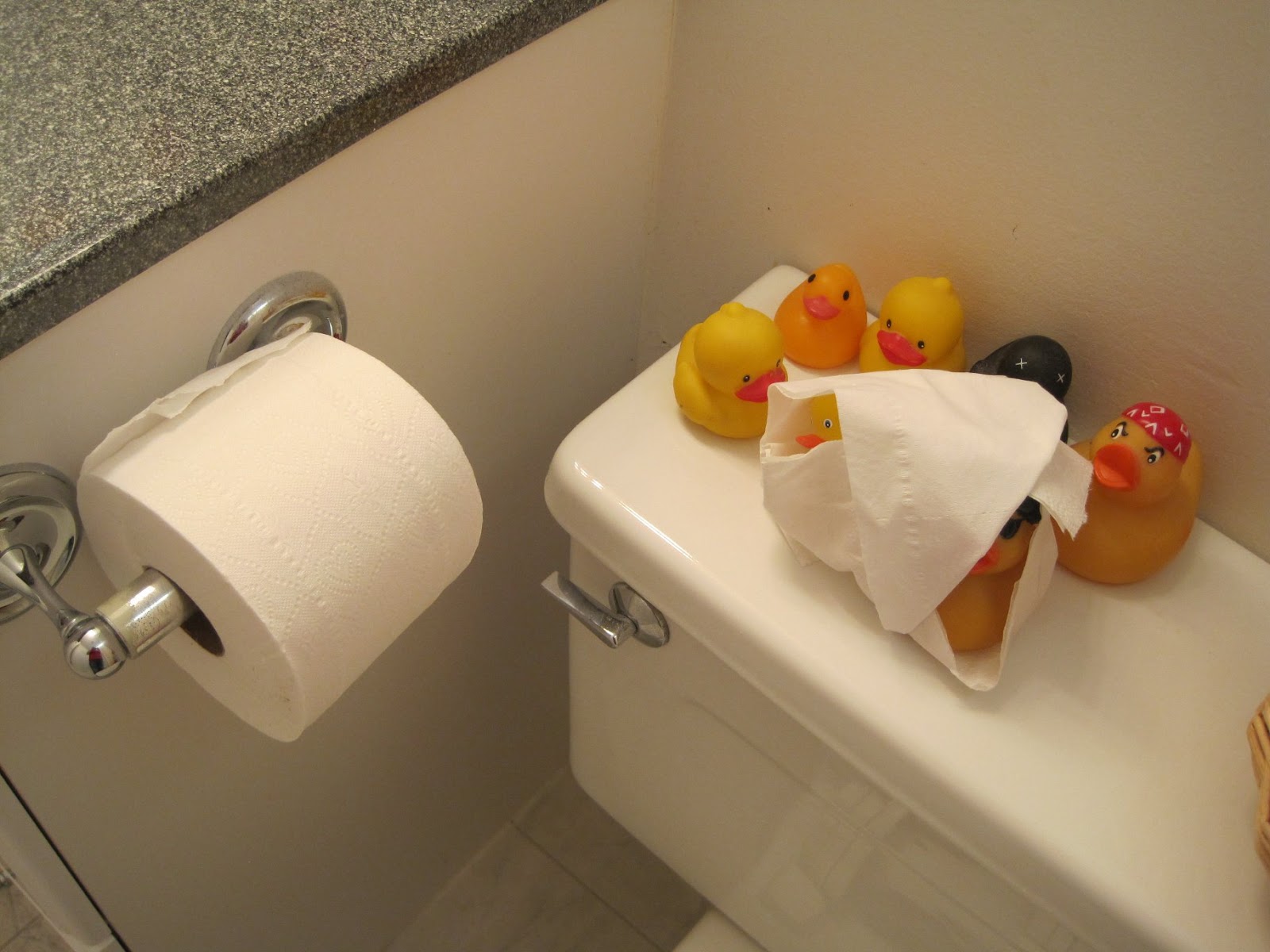
...turn to the task at hand. (Please ignore the ducks. They've invaded our bathroom and nothing we can do will dissuade them from hanging out atop the toilet tank.)

The bar across the center of this TP dispenser is spring-loaded. With boldness, grasp one end of the bar (it doesn't really matter which one -- just pick a side)...

...push firmly toward the other end, and guide the bar down and out of the brackets.

Assuming the spring-loaded bar didn't make a break for freedom and leap toward the floor, you now have a bar with an empty TP roll on it.

As the ducks look on in wonder, grab the empty roll and slide it off the bar. Houston, we have separation.

Once the empty roll is off, feel free to recycle it, craft it into some treasure of trash, or just fling it in the bin with utter insouciance. (Live for the moment, I say!)

Now pick up your trusty new roll of toilet paper...

... and slide the bar right through the handy-dandy hole in the middle.

The never-ending jihad known as Over or Under will not be discussed here. You figure out what works for your household and leave me out of it, OK?

Now you're going to perform a reverse version of the maneuver you used to get the bar off: fit one side of the bar into one bracket...

... press the bar in until it compresses a little...

... and guide the other end of the bar into the other bracket.

Mission accomplished! You now have a working roll of toilet paper, ready to go.

What you choose to do with it next is up to you.

Tuesday, May 28, 2013

How to help a grieving friend

Snark-lovers, be forewarned: for obvious reasons, this one isn't going to be funny.

All right, you're young and strong and even if you don't admit it, you may secretly believe you're invincible. But all that changes abruptly when someone close to you dies. Someone you saw all the time, someone you cared about, someone whose presence you probably took for granted is gone, and you will never see that person again in your life. Not only do you miss that person terribly, but you realize that if he or she died, then so can you. Suddenly your own mortality becomes very real. This may be the reason why so many people try to avoid someone who's grieving -- they're trying to evade the unsettling reminder that someday they, too, will die.

In the West our attitudes toward aging and death have grown increasingly unhealthy; we try to hide from death, box it up, pretend it doesn't exist. But death is a part of life. It can't be evaded, and frankly it shouldn't be. Yes, going through grief is indescribably painful. Yes, it's frightening to contemplate your own death and what may or may not lie beyond it. But it's healthier to face up to the pain and fear, to let yourself feel them, to walk through them, to accept them for what they are, and eventually to come out the other side. As with many other bogeymen, death can only hurt you with the tools you choose to give it.

With this in mind, what's the adult way to help a friend who is going through the aftereffects of a loved one's death? Well, everyone handles grief a little differently, so you'll need to adapt this list to individual circumstances, but these are a set of general guidelines.
  1. Listen. When someone dies, quite often a survivor wants to talk about it -- about shared memories of the deceased, about the circumstances surrounding the person's death, about what it's like to go through grief. Many people are uncomfortable hearing these things and will therefore avoid talking to the survivor, but providing a sympathetic, listening ear is one of the most compassionate things you can do for a grieving person. You shouldn't push the survivor to talk, but be comfortably open to conversation about the dead person -- don't shy away from mentioning him or her by name, or talking about things he or she liked to do.
  2. Be prepared for unpredictable emotional responses. Grieving people can be laughing one moment and crying the next; they can be numb or stoic for days at a time and then suddenly begin raging against the unfairness of a cruel world. Remember that these sudden storms of emotion are not to be taken too personally. Life after a loved one's death is like navigating an emotional minefield. You may think you're moving along just fine, and then a passing thought, a word or phrase, a particular scent or visual will trigger a memory that devastates you all over again. Expect these responses. Although they may seem unreasonable, they are a normal part of grief, and over time they will decrease in frequency and intensity.
  3. Bring food. Grief is a physical phenomenon as well as an emotional one. Survivors often feel dizzy, disoriented, physically cold and shaky, especially in the first few days after a death. They often remember events out of sequence, and may have trouble sleeping or eating. If you ask them whether they're hungry, they will often say "no" even if they really need to eat. So don't ask. Bring over something easy to digest, such as soup, ice cream, smoothies or gelatin, and hand them a serving. No need to force it on them; they will probably take a spoonful or a sip just to be polite, and often that's enough to stimulate the hunger response. A week or two later, if you wish, you may inquire about bringing over a more substantial meal -- comfort food is a good choice.
  4. Decide what you can do to help out. Survivors are often physically and mentally exhausted after a death, and have a difficult time making even simple decisions. Asking some variation of "Is there anything I can do?" isn't useful, as the survivor is usually unable to focus on the question and formulate an answer. Instead, make a short list of things you're willing to do, go to the survivor and present it like this: "I can drive you places, I can pick up groceries, I can take care of your bills, or I can watch your children. Which one would be most helpful right now?" When it comes to answering questions, multiple choice is always easier than essay. Then once the survivor has made a choice from your list, follow it up by doing what you offered to do. (This shouldn't have to be said, but I'm saying it anyway.)
  5. When possible and appropriate, offer financial help. This is sensitive territory, and it must be handled sensitively. In cases where the deceased was the primary breadwinner and there were no contingency plans in place such as a will or insurance, the survivor(s) can fall into financial trouble very quickly. But often a survivor is not comfortable asking others for money, due to a desire for self-sufficiency or simply an all-consuming exhaustion. You needn't wait for someone to ask, though. You can send money anonymously if you have the means, or take up a collection for the survivor(s) through a crowdfunding site. But before you do so, please take into account the feelings, needs and desires of the survivor. And don't use money as a substitute for engaging.
  6. Please, please, please, think before you speak. Sometimes people are so keen to have something to say to the bereaved that they put their feet in their mouths. Don't tell the survivor how hard this is for you -- share that sentiment with a friend further distanced from the tragedy. And even if you believe it, DO NOT tell survivors that the death was God's will, or that God must have needed the dead person. It's not comforting, and can actually create long-lasting psychological pain. My sister still has not made her peace with a God who she believes took her father away, because when she was a small child some well-meaning idiot suggested to her that God needed her daddy in heaven more than his wife and six small children needed him on earth. It's better to keep your comments simple. "I'm so sorry for your loss" and a gentle hug, if appropriate, are sufficient.
  7. Help the survivor find something to look forward to. One of the things my mother has often said about my dad's death is that, concurrently with her grief over his passing, she grieved over the death of so many of their shared goals and dreams -- the things they planned to do together. Many survivors, especially in the first few months after a loved one's death, have a tough time finding reasons to keep living. You can't just drag them here and there, but if you find activities you think they might enjoy, tell them. Sign up for adventures and invite them to come with you. Have them accompany you to a new restaurant for lunch. Your job is not to set the survivor up with anybody -- frankly, that's nobody's business -- but to provide opportunities once in a while for the survivor to develop new interests in the next chapter of his or her life.
  8. Be patient. Grief isn't like getting the 24-hour flu. It takes time; how much time varies from person to person. You can't expect a survivor to bounce back right after the funeral, or in two weeks, or even in six months. Grief is a journey taken on foot through an unknown wilderness. You can provide oases of rest and support now and then, but you can't hurry people through the process; trying to push them to be done with it only delays the journey. Try to show the kind of grace, patience and love you would want others to show you if you were taking that same journey, and have faith that your friend will eventually reach a point where his or her life begins to get better.
If you truly seek to be something more than a fair-weather friend, you should do what you can to support your friends in hard times. It will be difficult and emotionally wrenching to do so. But true adults are brave enough to undergo potential pain for the sake of the people they love and care about, and in so doing, will grow stronger from helping to lift and lighten another person's burden of grief.

Thursday, March 28, 2013

When and how to tip

Before diving right in, let's cover the basics: what is a tip, and why do we bother to tip in the first place?

Service tips (as separate from, say, "stock tips" or "cow tipping") are small sums of money given to thank people for serving you. In the United States and most other Western countries it is customary to tip restaurant servers, cabdrivers, bartenders, hotel bellboys, pizza delivery guys, and anyone else who works in similar service industries. The standard rule of thumb for tipping is 15% of the overall bill, before any discounts are applied. (This is easier math than you think. Say your bill is $29.50. Scoot the decimal point one place to the left to get 10% -- that's $2.95. Divide that amount in half to get 5%, about $1.48.  Add the two together and you end up with 15%, or $4.43.)

Why do we tip at all? It's hard to say. Tipping is a very old social custom in the West, dating back at least to ancient Rome. In the old days, it was a kind of noblesse oblige -- superiors sharing a smidgen of their bounty with their social inferiors -- but in an egalitarian society it's become a way of showing people that you notice and appreciate their efforts. Tipping is also a sign of good manners.

There are practical reasons to tip, which you already know if you've ever been a waiter. In some service industries -- particularly in restaurants and bars -- the owners deliberately pay the waitstaff close to slave wages, expecting them to make more than half their money from tips. This is supposed to encourage waitstaff to be friendly and attentive to customers, which in turn reflects well on the establishment. Welllll, SOMEtimes it works that way. Far too often, however, a hard-working waitress hustles her tail off for a big group of customers who finish their meal and leave her bupkis for her efforts. That's just not right. (Worse, I've heard horror stories of douchebags who return to the table after a meal to steal the cash tips left by other diners in their party. Hello, douchebag! My knee is delighted to meet your groin.)

Cash tips are accepted just about everywhere, but many services now allow you to pay (and add tips) with a debit or credit card instead, which is handy if, for instance, you're leaving New York City and you have no cash left on hand to tip the cabbie who just zoomed you to JFK in record time. (GO NEW YORK CABBIES!)

General rules


  • Tip at the end of service. Since tipping is a reward for good service, you usually tip at the end of the service rendered (as you leave the restaurant, the cab, the bar, etc.).
  • Tip discreetly. Don't flash around a massive wad of cash or make a big song and dance number out of the process; it makes you look like a complete goober. (Not to mention that if a thief is watching, he'll know exactly whose pocket to pick later.)
  • If you're leaving a tip of more than $1, don't tip in change. It just looks cheap. If you need to, you can usually exchange coins for bills with the cashier.
  • Be thoughtful of service people. They have tough jobs, often get yelled at, and many are on their feet all day long; it's a relief to come across someone who demonstrates a little patience.
  • In the name of all that's holy, don't be a snob. Displaying genuine kindness and making sure the people around you are as comfortable as possible is the truest sign of good manners.

Restaurant, bar, and delivery service


As mentioned, 15% of the total bill is the most common tip for waiters, bartenders and pizza delivery people, though you can give more if the service was fantastic or if you're just feeling rich and whimsical. Although some people suggest leaving 10% for bad service, I don't recommend it; if your waiter was spectacularly rude or awful, don't tip at all. Instead, ask to speak to the manager and discreetly explain what happened. (That's right, TATTLE.)

If you tend to go to dinner with a huge mob of people, examine the bill before you leave a tip; some restaurants add a gratuity to the bill if there are six or more people in your group. Also, if you hate trying to figure out who pays for what at the end of a meal, ask the waiter for separate checks when you are first seated. Worried someone in your group might be a tip-stealing douchebag? Don't tip in cash. Pay for the meal with a debit or credit card and add the tip to the check at the end of the meal. (Make sure you write down the tip and total on your own receipt, so you don't forget later.)

You don't have to leave a tip if you're picking up take-out food. You also don't have to tip fast-food servers or baristas (though the baristas will sure try to convince you otherwise).

Holding and moving your stuff


Bellboys, porters, skycaps and other people who help you move your luggage around should receive $1 per bag ($2 if you're carrying lead soldiers or skiing paraphernalia), though some suggest a minimum of $5 for the service. Tip in cash, since most porters don't shlep a card reader around with them.

Professional movers and furniture delivery people do some back-breaking work -- especially if you own a grand piano and are moving into a fifth-floor walkup. Each person who helps you move should receive between $15 and $25. Most movers also appreciate clients who offer cold drinks and/or pizza at the end of the job (because, hey, nom).

Coat checkers should receive $2 when you get your coat back. I've never used valet parking in my life, but if you do, the standard tip is $5.

Generally you shouldn't tip grocery store baggers, unless they work for tips. (As a teenager, my husband bagged groceries for tips on an American military base, and consequently developed some unusually powerful forearm muscles. Now he is Popeye the Sailor Man!)

Grooming and hygiene


Hair cutters, manicurists, masseurs/masseuses, estheticians, spa attendants, and anybody else who makes ya look purty should receive about 15% of the total bill as a tip -- more if they've done amazing work. Shoe shiners should receive a $3 to $5 tip.

High-end restaurants and shopping centers sometimes hire restroom attendants. (Honestly, I wish they wouldn't, because a) I can wash my own hands just fine, thanks, b) I'd prefer some privacy, c) it feels like yet another attempt to squeeze cash from customers and d) I almost never have a tip handy since I'm more likely to encounter a unicorn than see a restroom attendant. But that's just me.) $1 in bills or change is an acceptable tip for such service, if you feel inclined.

You shouldn't tip sales clerks at cosmetics stores, as pushing beauty products is part of their job.

Gift tips


You can, if you choose, give a gift tip to people with whom you regularly do business. (Boxing Day, the day after Christmas, is a holiday set aside to do just this.) If you want to gift tip, the standard amount is approximately a week's salary. If it seems appropriate, you can offer a box of good chocolates (no, NOT the wax-covered crap you find in drugstores) or a bottle of quality wine as a gift tip instead.

What if you have no money?


Sometimes you know you should leave a tip, but you're out of cash and can't use a card. If this happens, get the service person's name and the address of his/her business (try asking for a business card), and mail that person a tip later. Think about it -- if you had this person's job, wouldn't you want someone to make the effort for you?

This is just a rough guide to get you started with tipping; it should cover most circumstances you're likely to encounter as a young adult. If you travel overseas or start living large, though, you're on your own. (I can't be expected to do all the legwork for you. Take some incentive and look it up!)

Thursday, March 21, 2013

How to borrow and return things

In my life, I've had to deal with people who were abysmally clueless when it came to borrowing and returning items. I've lent out books that were gone for years and finally returned with broken spines and notes written in the margins, lent out CDs for ages and had them returned so scratched up they would no longer play, and lent out movies that simply disappeared for good. (Captain Midnight has had it even worse -- he once lent out his hard-to-find copy of Urshurak, illustrated by the brothers Hildebrandt, and when it finally came back all the color illustrations were gone, surgically removed with a razor blade.)

Have you ever taken care of a small child? If you have, you know it's crucial to toddler-proof your home so that your cherished possessions aren't smashed, swallowed or turned into teething rings by a rampaging two-year-old. Well, it doesn't matter what your chronological age is; when you don't borrow or return things properly, your family and friends will think of you as an overgrown toddler. Forget toddler-proofing -- they'll bolt the door when they see you coming. So if you ever want to borrow anything again, learn the right way to borrow items, the right way to give them back, and what you must do when something goes wrong.

Borrowing


Get permission first. The industry term for borrowing something without expressly getting permission is "stealing." Yes, even if you return it when you're done. If the person who owns the item says you can't use it, you can't use it, no matter how much you might need it. Go find someone else to bum off.

Don't treat it like it's your own -- treat it better. You can carve your own DVDs into snowflakes and use your own glassware for target practice if you really want, because they're your things and you can choose to destroy them. But if someone else has entrusted these items to your care, it's your duty to treat them like gold. If it's a book, protect it from dust and spills, don't dog-ear the pages, and be gentle to the spine. You want it to go back in at least as good a condition as you received it (about which, see more below).

Keep close track of things you've borrowed. I have trouble with this, especially when it comes to books, which is why I bring it up. If you also have trouble remembering what is and isn't yours, you could keep notes in a regular place with a running tally of items you've borrowed, the approximate date you borrowed them and the date they need to go back. It also helps to have a specific spot where you keep borrowed things, to remind yourself that they're just visiting and need to go home.

Never, never sub-lend. You'd think this would be obvious, but I'm saying it anyway so no one can claim ignorance later -- if you've borrowed it from someone else, you cannot lend it out to a third party. Common sense dictates that the more an item passes from hand to hand, the greater the chance some kind of disaster will occur. Besides, it's not yours to lend out, doofus.

Returning


Return items promptly. Don't be a dirtbag and hoard borrowed items for months and months, forcing the lender to contact you repeatedly and ask when you're going to get around to giving her stuff back. And don't tell me you can't admit to the lender that her item got broken or lost. Go directly to "Making Restitution" below (do not pass "Go," do not collect $200).

Return items in as good as or better than their original condition. What does this mean? If you borrow a car, give it a wash and top off the gas tank. If you borrow tools, shine them up. If you borrow furniture, make sure it's clean and in good condition when it goes back. You get the idea. Send it back nice and well-kept, even if it wasn't in that great a condition when you borrowed it. You want to fill lenders with relief and happiness when they get their stuff back from you. (The one exception to this rule: don't make an "improvement" to an item if doing so would decrease the item's value. For example, NEVER shine up someone's coin collection or clean an autographed baseball!)

If you borrow food, return it. I don't know how often people go over to a neighbor's house to "borrow" a few eggs or a cup of flour any more, but if you do, you should "return" a few eggs or a cup of flour the next time you stock up at the store. At the very least, if it's appropriate, you could share with your neighbor some of the goodies you made from the borrowed ingredients.

Thank the lender. Borrowing is a privilege, not a right. I don't care what your communist college professor says; individuals can and do own things and have every right to control their use. If someone trusts you enough to let you borrow something she cares about, the least you can do is thank her for that trust. If for some reason you can't thank your lender in person, a written thank-you note is appropriate.

(By the way, a word to the wise about returning a very commonly borrowed item: whether you call them shopping carts, shopping trolleys, wagons or buggies, there are only two proper places to return them when you're finished grocery shopping. Those two places are 1) inside the store or 2) in a cart corral in the parking lot. You do not get to take them home (remember that bit about stealing?), leave them in the middle of the parking lot, wedge them between two parked cars, shove them onto the sidewalk, or abandon them next to a handicapped parking zone so wheelchair-bound shoppers are trapped in their vans. And if I see you doing any of this stuff I will THUMP you, so don't even.)

Making restitution


Sometimes borrowed things get lost, damaged or broken. It happens to all of us at one time or another. What happens after that, however, determines whether or not people will ever trust you to borrow their things again, so read carefully.

Admit what happened and apologize. Don't try to sweep everything under the rug. It won't work. Instead, have the testicular fortitude to admit what happened while the item was on your watch. Let the lender know how sorry you are this happened. Then, before the owner even has to ask, move immediately to the next step:

Fix it. I've met people who have crashed others' cars, broken others' furniture, stained others' clothing and killed others' pets, and who seem to believe that all they owe anyone for these misdeeds is a heartfelt apology. SORRY, I CAN'T HEAR YOU OVER THE SOUND OF YOUR WRONGNESS. If the words "I'm sorry" could fix a broken windshield, find a missing pair of shoes or make the dog un-eat your cherished leatherbound copy of the Pop-Up Kama Sutra, they would be sufficient. Since they aren't, your next responsibility is to make restitution. That means you pay to fix the damage done to the item you borrowed while it was in your care, even if you weren't directly responsible for causing the damage.

Aww, is that going to set you back some? Poor pookie. Didn't stop to think it would probably set back the owner of the item that got broken or lost, though, did you? Why should he have to pay for your indiscretion? Right; he shouldn't. Doesn't matter if you think he makes enough money to eat the costs; you're at fault. And if the item was particularly expensive, and you're going to be paying it off for quite some time, just maybe it might occur to you that this was a costly mistake and you're not going to repeat it. Congratulations; you is learnin' stuff!

Now, are you going to borrow and return things the right way, or are you gonna be the dirtbag who never gives stuff back, or gives it up so scratched and dented that it has to be replaced anyway? (Hint: if you've read this and I catch you being a dirtbag, I will likely do some scratching and denting of my own. Grrrrr.)

Wednesday, December 5, 2012

How to give and receive gifts

It's getting to be that festive time of year when people start thinking about holiday gifts, so it's time we had The Talk. Here it is:

Gifts are usually meant to be reciprocated. In simpler terms, if someone gives you a gift, you should get that person a gift too.

True, gift-giving is not supposed to be a strictly tit-for-tat experience -- but you also have to consider human nature. If you receive (and expect) presents from others for years, but you never offer others a thing in return, you are subtly telling people you don't really want to participate, or they may assume you are just a worthless ingrate; either way, they'll stop giving you presents. So: if you like getting gifts, consider giving them as well. It's a sign that you're thoughtful of others, a mark of adulthood.

But I always pick rotten gifts!


So you don't have a natural knack for gift-giving. Fortunately it's a skill that can be learned, and you will improve with time and practice. You're not going to get that practice in if you never try, right?

In the meantime, get a shopping buddy. Find a friend who gives great gifts, grovel shamelessly for help, and take him or her shopping with you. (Buy this person a hot chocolate or something afterward as a gesture of thanks.) Barring that, there are several online services designed to help bad gift-givers make good choices. Dive into one of these if you're completely stymied.

Some things to take into consideration when looking for a good gift:
  1. It should be something the recipient actually wants, but might not splurge on.
  2. It should be something you're not ashamed to give.
  3. It should reflect the recipient's tastes and interests.
  4. Unless the recipient specifies otherwise, it shouldn't be highly practical.
  5. It doesn't have to be expensive.
  6. If you're getting something for the person who has everything, offer an experience.
Still in doubt? You could always just ask. Your gift recipient may have some good suggestions or a public wish list somewhere. Even if you don't end up buying an item from the list, it should give you a good idea of the person's likes and interests.

If you can't think of a blessed thing, here are a few standby gifts: movie tickets, gift cards (to a place where the recipient actually shops), bouquets or live plants, homemade bread or cookies, a bottle of good wine or sparkling cider, good coffee or hot cocoa, homemade jam or preserves, a box of quality chocolate (the stuff they sell at the drugstore doesn't cut it), a bestselling book or a good-smelling scented candle. Take into account any allergies, sensitivities or dietary restrictions when making your decision (don't give wine to a teetotaler, for instance).

But I'm broke!


As I write this, the economy is sour and times are tight. Many people are out of work; if you're fortunate enough to have a job, you may be barely scraping by. How are you supposed to get presents for anybody when you have little or no money? There are several options.

First, offer experiences or services. When I didn't have much money and my nieces and nephews were young, I would present them with fancified written scrolls that entitled them to a full day of fun with their auntie at the venue of their choice. We'd agree on the date and the recipient would pick the place, and we'd go have some one-on-one time. This gift worked well for kids, but probably wouldn't cut it for adults. Another sibling used to create personal coupons good for various services: mowing the lawn, cleaning windows, foot rubs, etc. (NOTE: IF YOU OFFER THESE SERVICES, BE PREPARED TO MAKE GOOD ON THEM. Offering someone a coupon for a car wash and then refusing to wash the car is an empty gesture and, frankly, kinda stupid on your part; you might as well not bother. Offering an experience means you're spending time on a person, rather than money.)

Second, make something. Be careful about this route, because it can be potentially disastrous. Take the time to think before you start a major project, and consider the good gift rules again. Remember, it needs to be something you're proud to give as a gift, not some inexplicable whatsit cobbled together from pipe cleaners and duct tape. And it needs to be something the recipient wants as a gift. If you spend hours knitting a pair of mittens for someone who thinks hand-knitted items are cheap and tacky, both of you will end up angry and disappointed. Hint: if you're a good baker, homemade baked goods like cookies and quick breads are often very well received.

Third, shop secondhand stores. If you have a little money, a lot of time and a good eye (or just a great shopping buddy), you can find truly gift-worthy items in secondhand venues. Classic hardback books in great condition are especially likely secondhand gifts. The rules for gift-giving still apply here, with an additional caveat: the item you choose should not look (or smell) secondhand.

Fourth, trade. Barter some object or skill you have for something else you'd like to give as a gift. Give yourself plenty of time to do this; bartering isn't as fast as paying cash and it requires more patience and effort.

If all else fails, you can do what my sister did in grad school: declare temporary gift bankruptcy. Let people know ahead of time that you can't afford to buy gifts this year, and that you don't expect them to give you a gift either. It's honest, properly sets up their expectations and lets them know that you are thinking about them, even if you can't afford anything. Remember, though, gift bankruptcy is temporary; you can't go on doing it forever and expect people to be gracious about it.

But I don't wanna!


At its core, gift-giving is purely optional. That means it's also completely optional for the people who currently give you gifts. They're not required to keep at it if you don't show any interest in participating.

Personally, I think the custom of giving and receiving gifts is fun and helps strengthen relationships between people. It's a particularly thoughtful way of saying, "I like you and I'm thinking about you."

How to wrap a gift


Nearly everyone agrees that wrapping makes the gift. (An unwrapped gift is just an object that's been handed to you.) There are many ways to wrap a gift, from the simple to the complex. Wrapping is partially determined by the shape of the gift itself (although you can always make it simpler by putting an oddly-shaped gift into a rectangular box and then wrapping that).

Don't know how to wrap a present? YouTube to the rescue!

Here's the basic way to wrap a square or rectangular gift with wrapping paper and tape. (If you don't have any wrapping paper, get creative. Try using color comics, foreign-language newspapers, kraft paper, butcher paper and twine, wallpaper samples, old maps, even sheet music.)

If you have a large square of fabric or a decorative scarf, you can wrap a present furoshiki style. (You don't need to understand Japanese to be able to follow along; just watch what she does.) Furoshiki wrapping is especially useful for oddly-shaped gifts.

Of course, you can go completely nuts with gift wrapping, but it doesn't have to be complex unless you want it to be.

How to receive a gift graciously


Not everyone knows the proper way to receive a gift. I've flubbed it on more than one occasion. (Once I opened a gift from a family member and said the first thing that crossed my mind, which happened to be something rude. My family member felt justifiably hurt at my insensitive comment, and I felt like a complete jerk. Which I was. Yeah, don't be me if you can help it.)
  1. If the person who gave the gift is present, thank him or her immediately, before you even open the gift. Gift-giving is a thoughtful act in itself and deserves recognition.
  2. If there's a card with the gift, open it first and read it. If someone took the time to get a card, the least you can do is give it the once-over. And it helps cement in your mind who the gift-giver is. (It also makes sense to check and make sure the present is meant for you, especially at a mass gift-giving event such as Christmas.)
  3. Open the gift carefully. It could be fragile.
  4. Regardless of what the gift is or how well you like it, it's proper to thank the giver. If he or she isn't present, write a thank-you note expressing your gratitude. If, like me, you have a hard time remembering who gave you what, get a pencil and piece of paper and write it down as soon as possible so you can write appropriate thanks later.
And now you know. Armed with your new knowledge, go forth and seek out amazing gifties for all and sundry.

Friday, November 23, 2012

Common courtesies: social behaviors every adult should know

Courtesy is the art of treating everyone, from friends to strangers, with kindness. Unfortunately it seems to be a dying art, considering how many people don't know -- or just don't bother to follow -- the most common courtesies.

Maybe you think courtesy is stilted and unnatural, and you just want to be free to do whatever you like. But if you do so, you're not really fit for social living. Human societies create manners and rules of etiquette not to cause stress, but to ease social friction, making it simpler for large numbers of people to live together peacefully. So unless your future job description is "mountain man," "bunker inhabitant" or "castaway," you need to follow these rules.

Arrive on time. This is a tough one for people like me, who are world-class procrastinators. It can also be a challenge for the rare group of people who perpetually arrive early. But both extremes are rude, and in most cases they can be avoided with a little planning. Remember, adults are honest, and that also means keeping your word about being where and when you say you'll be. If you are unavoidably detained, send a message explaining why.

Leave on time. When the party's over, the dishes are washed and put away, and the host is sweeping up, don't be that one person who lingers behind like the smell of a chili toot (and is just as unwelcome). Go home, and let other people get some sleep.

Return things you borrow.

In a crowded situation, be prepared to give up your seat to the elderly, the infirm and the pregnant. If for some inexplicable reason someone gets angry at you for offering up your seat because he or she does not fit one of these categories, you may respond with, "I'm sorry. You just looked tired and I thought you might want to rest for a while."

Open the door or keep it open for the person behind you. Again, occasionally you will run across someone who has an illogical aversion to this act of thoughtfulness. Don't let it dissuade you; people can be funny creatures. "I certainly didn't want to let the door slam shut in your face" is an acceptable response to anger in the face of this courtesy. And if someone opens the door for you, be sure to thank him or her.

Do not touch other people without their express permission. Common violations of this rule include (but are not limited to): patting a pregnant woman's belly, rubbing a bald man's head, playing with another person's hair, or -- yech -- grabbing at breasts, butts or crotches. You may not be able to help coming in contact with a stranger in a standing-room-only situation, but even then, remember what you should've learned in kindergarten and keep your hands (and other body parts) to yourself.

Know and practice your movie theater etiquette. 'Nuff said.

Dress for the occasion. Too much of modern society seems to believe you can sling on jeans and a T-shirt and go anywhere. Wrong. Certain events -- weddings, funerals, church attendance, live theater, formal dinners -- require a bit more sartorial finesse. You don't have to look like you've stepped off the pages of Vogue, but gentlemen, get a real tailored suit/ladies, get a neutral-color dress that looks great on you, and dress up. Changing the way you look really does change the way you feel and act. It's almost magical.

Return phone calls and messages. Taking the time to respond to queries, even with a single sentence, shows a measure of thoughtfulness to others. And it's a lot less difficult to find the time to do this than it used to be, now that nearly everyone carries a cell phone. Oh, and by the way...

Cell phones are not to be used indiscriminately. I know, they're portable and they do seem to ring everywhere, but that doesn't mean it's socially acceptable to have a phone or text conversation in the middle of a checkout line, during a face-to-face conversation with a friend, in a movie theater, in the middle of class, while driving, in the library, or (worst of all) in a public restroom. And do not use your electronic pacifier as a way of detouring around real life. Engage! It's a lot more interesting than yet another round of Angry Birds.

Don't pick your nose in public. It's just gross. You are, however, allowed to carry a handkerchief or tissues and discreetly blow your nose if needed (except at the table). If for some reason your tortured soul cannot be at peace until that nasal nugget is gone, relocate your excavation efforts to a restroom stall or other place where you will not be observed. Be aware that nosebleeds are an occupational hazard. And please, wash your hands when you're done.

Don't spit in public. If you really need to expectorate, find a restroom and spit in the sink. Don't just hock up a big green slug on the sidewalk; that's disgusting, not to mention unhygienic.

Cover your mouth when you cough or sneeze. The Centers for Disease Control suggest that if you don't have a tissue at the ready, you should cough or sneeze into the crook of your arm, not into your hands. (Shaking hands with someone directly afterward can be a cringe-inducing experience.)

If you must smoke, use an ashtray.  Don't just dribble ash everywhere -- and when you're driving, don't fling your spent cigarette butts out the window.  It's disgusting, hazardous, and makes you look like the sort of life form that scuttles for cover when someone hits the light switch.

Don't go naked in public. (You'd think this wouldn't need to be pointed out, but the recent shenanigans of San Franciscans have made me reconsider.) Under normal circumstances, spontaneous public nudity is reserved for small children and the mentally infirm. Unless you're one of these two, stay clothed. Yes, yes, you have a glorious body and must share it with the world... whatever. We're not discussing your rights nor your personal aesthetic merits, but common courtesy. Most people in North America are uncomfortable with public nudity, whether the nude in question is an Adonis or an embarrassment. So button it up. Please. If a special someone really wants to see you naked, I'm sure that person will find a way to let you know.

When you make a request or give an order, take the time to say "please" and "thank you." These two small phrases manage to convey thoughtfulness and respect for others who, after all, are doing something for you. They can create huge social benefits from a minuscule time investment.

Don't gossip; it's caustic. Is it necessary? Is it true? Is it kind? If it doesn't follow all three rules, it's gossip. YOU CAN RUIN PEOPLE'S LIVES with this crap. So don't do it.

Don't swear within earshot of children. (This rule used to apply to women as well, but it was crafted in a day when women were routinely referred to as "the fairer sex." Since some feminists consider this thoughtful act of gentility to be somehow demeaning to them, I've set it aside.) Likewise, please refrain from discussing your illicit drug use, your sexual exploits, or the joy you find in killing small animals, at least while children are listening. Some people might argue that children are exposed to vulgarity and profanity by grade school anyway, so there's no harm done. I would counter that most children are also exposed to nudity (their own or others') by that age, but that doesn't give you carte blanche to strip and run naked through a kindergarten class.

If you're angry at a person or situation, don't make someone else suffer for it. This covers a whole range of behaviors from verbal cruelty to full-out physical abuse. If you've got to take your frustrations out on something, go to the source of the problem and work it out. Or get a punching bag. That's what they're for.

When you've done something wrong, apologize. No, we're not talking about fake apologies like "I'm sorry you didn't understand" or "Well, I'm sorry, but it wasn't my fault!" or any of that crap. We're talking real, face-the-person, look-right-in-the-eyes, sincere apology. Being able to admit (and, when possible, atone for) your mistakes is the first step toward ensuring you won't make the same mistake twice. And it's a huge sign of personal maturity.

Know any other common courtesies I've left off this list? (I'm sure I have.) Let me know, and I'll add them in.

Thursday, November 22, 2012

How to behave in a movie theater

If you're any kind of film buff, you know that we live in an age of uncountable riches. Titles from all over the world, representing close to the entire range of cinematic history, are available at our fingertips. But there's one unfortunate side effect to this plenty: in the age of DVDs and Netflix, people have forgotten (or have never learned) how to behave themselves in a movie theater. So shed your couch potato ways and school y'selves!
  1. Don't even bring your phone into the theater.
  2. Don't bring an infant into any movie. If you can't afford a sitter, you can't afford to see the movie in theaters. Period.
  3. If you're going to take children to a movie, do your homework. Movie reviews exist for a reason. The best reviewers give an informed opinion without completely spoiling the plot. Likewise, the MPAA rating system is imperfect, but most movies are rated PG, PG-13 and R for a reason. You really want your six-year-old sleeping in bed with you for a month after being traumatized by Akira, because you just assumed all animated films were kid-friendly?
  4. Even if they're usually well-behaved, most kids don't know how to sit through a movie. They were raised on DVDs, where they can stop the film at any time to ask questions, get a snack or go potty. Kids who are not trained will scream, cry, wander around and ask questions in their "outside voices" the whole time. You will have to teach them how to behave. That means you have to go with them. Don't you dare treat the theater like a drop-in babysitting service. I will find you.
  5. On the flip side of the equation, if you're seeing a movie primarily marketed to children, you lose the right to whine about how the theater has too many rugrats. If you can't stand kids, go see a late-night showing of the film.
  6. You came to watch the movie, so watch the movie. It's OK to laugh, cry, "aww," even gasp in the theater (as long as the movie's actually scary), but wait to discuss the plot points afterward. Don't sing along with musicals, unless you're at a screening that encourages audience participation. And no matter how much common sense and/or lung capacity you possess, the people on the big screen aren't going to hear or heed your unsolicited advice.
  7. Concessions are meant to be food, not ammunition. No matter how annoying the kid in front of you is being, that doesn't give you the right to fling popcorn and Junior Mints at the back of his head. You can, however, talk to his parents or an usher and get him removed from the theater if he's being a real twerp.
  8. If you take it into the theater with you, carry it out when you leave. Yes, that means popcorn buckets, candy wrappers and soda cups. Put them in the trash as you go; don't just leave them for the ushers.
  9. If you arrive at a showing early, take a seat in the middle of a row so people can fill in on either side of you. If you suffer from a weak bladder, a weak stomach, ate a honkin' bean burrito half an hour ago, or have any other medical issues that require you to make several exits during the showing, sit at the end of a row near the exit so you can leave the theater as necessary without having to leapfrog madly over other patrons.
  10. I wish I didn't have to point this out, but don't see a movie in theaters while you're sloppy drunk or stoned out of your gourd, and don't bring drugs or alcohol into the theater with you. If a flick is so bad that you have to be wasted to enjoy it, maybe you should just go get your money back and watch it on DVD.
  11. Speaking of getting your money back, if you've stumbled into a real turkey of a film, you don't have to make a big indignant song-and-dance number out of it. Not everyone else may share your opinion of the film. Just leave quietly and ask the management for a refund. (And don't wait until the end of the movie to do it. If you sit stoically through a stinker and then ask for your money, they will question your motives and your sanity. And you won't get a refund.)
  12. Our final rule buries the needle on the Grossometer, but it has to be stated anyway. Do not have sex, or anything like it, in a movie theater. Those ushers aren't paid nearly well enough to clean up after your shenanigans -- not to mention that you could be arrested for public lewdness, and possibly for general stupidity.
Now go forth and crunch your popcorn in peace. (And if I happen to catch you texting during a film, I'm going to break rule 7 and drench your useless noggin with 32 ounces of diet root beer.)

Thursday, November 8, 2012

How to use social media wisely

Social media sites such as Facebook, Twitter, Pinterest, etc. are relatively new, so few etiquette experts have published pronouncements about their use and misuse. But as you or your friends have probably already demonstrated, there are plenty of ways to put your foot in it online.

It's best to think of social media as a big, unstructured, somewhat goofy party where you can hang out with your friends. Most rules of parties apply to social media, to wit: if you want to have a good time, be friendly, be funny, listen to others, and share ideas and thoughts that interest people. If you get maudlin, haughty, dramatic, hyperactive, mean, self-righteous or sloppy drunk, people will quietly drop you and move to more interesting circles.

Here's the other thing. Unlike most parties, you're being tracked. Even on sites where you can delete comments after the fact, it's best to assume that what happens on social media stays on social media... FOREVER. So one of the first DO rules for social media is:

DOs


THINK BEFORE YOU POST. "What's on your mind?" "What's happening?" "What are you looking for?" Social media sites are programmed to tempt you to answer these questions. You might throw caution to the wind and answer any question you're asked, or vomit up any old stray thought for others to read. You also might down a bottle of Everclear and then try to drive your dad's vintage Ferrari; both are equally stupid ideas. Remember, your parents, your grandparents, your girlfriend/boyfriend, your future employer or your kids could be reading what you write (and making associated judgement calls about your sanity). So rev up your brain and take a minute to think about how your dashed-off comment could affect you and others -- not just now, but for a long time down the road.

In the same vein, KEEP YOUR PRIVATE INFORMATION PRIVATE. To paraphrase Ben Kenobi, "You don't need to see my identification." You need not provide all the information every social media site requests. Frankly, it's none of Facebook's business what your address, cell phone number, birthdate or voting preferences are. Even if the site itself doesn't use this information to market to you (yeah, right), Facebook and other sites are notorious for having accidentally released sensitive user information to the public in the past. So give them only the sparest of details to establish your identity. You aren't the droids they're looking for.

CHOOSE YOUR FRIENDS WISELY. On most social media networks, you will get friend requests from complete strangers. Helpful hint: you don't have to add them as friends just because they requested it. My personal rule on Facebook: if I've never met you in person, I reserve the right not to add you as a friend. (Hey, you're probably awesome. I just want to verify that face to face.)

ASSUME YOUR PRIVACY IS ONLY AS SAFE AS YOUR LEAST CLOSE FRIEND. I've seen people post their new mailing addresses and telephone numbers in their status feeds on Facebook, with the idea of "Well, only my friends will see it." WRONGO. First off, social media sites have sometimes released private information to the public, so you can't count on the site itself safeguarding everything you write. Second, I want you to stop reading this for a second and go over to Failbook. Read some entries, laugh, then think about how easily some goofy thing you wrote for the benefit of your online friends could be reposted offsite by an angry frenemy looking for revenge, or a clueless friend who has no concerns about anyone else's privacy. Yeah. Be careful out there.

PART WAYS QUIETLY. The time will come when you must decide to unfriend, unfollow, or otherwise dissociate yourself from someone in social media. Do it quietly, without comment. Chances are most people won't even know you've gone, especially if they have gobs of friends (after about 50 it gets hard to keep track of everyone). If the person you've unfriended notices your absence and wants to know why you've gone, explain privately and simply. Try for honesty without bluntness: "I'm trying to get away from online politics" is more well-put than "If I see one more post from you about Candidate X, I'm loading up and heading for the clock tower."

DON'Ts


This is a bigger list, for reasons that may become obvious. DO NOT do any of the following on social media:

SHARE TOO MUCH. This isn't just an issue with social media; we have gone from being a nation of reserved and laconic individuals to a country of people pressing TMI on everyone they encounter.  The occasional recipe posting or "Standing in line for the midnight showing of RHPS -- can't wait!" is fine in small doses, but you needn't (and shouldn't) describe in detail the travel adventures of every foodstuff to brave your alimentary canal, relate and rate your latest sexual escapades, or explain where and how many times you pooped in the last 48 hours. I don't care if you're the freaking President of the United States -- nobody wants to know if you woke up constipated this morning.

SHARE TOO FREQUENTLY. This is a tough line to draw -- some people use social media sites more frequently than others, and some social media sites such as Twitter encourage more frequent use -- but using the TLAR method (you know, "That Looks About Right"), I'd say if you post more than 10 status updates in a 24-hour period, you need to lay off the caffeine for a while. Same deal if you have to comment on every status update you read (yes, as an unrepentant snarker I've been guilty of this behavior). Spamming your friends' message feeds with reposts, shares and comments is more annoying than endearing, so take it easy.

SWEAR LIKE A SAILOR. I don't know how much more bluntly I can put this: using foul language doesn't make you sound like an adult. It does make you sound boorish, stupid, infantile and thoughtless, so if that's the impression you're going for, don't let me stop you. But if your status updates are so peppered with F-bombs that your friends and followers practically glow in the dark, you are going to lose some of them. Just FYI.

POST CRYPTIC CRAP. You know the kind of updates I mean, the one-liners with no attendant explanation: "I knew this day would come." "Can't believe that just happened." These aren't so much tantalizingly mysterious as they are signs you're being a high-maintenance dweeb. Look, if you work for the CIA, you can get away with murmuring encoded phrases to shady contacts from a park bench somewhere. But make yourself understood online.

MAKE PASSIVE-AGGRESSIVE ANGSTY COMMENTS. "If I don't get at least 10 replies to this post I'm deleting my account." Bye! There's also this common trope: "Filled with despair and ennui. Cannot elaborate." Fishing for sympathy much? If you really don't want to explain why your life sucks today, don't bring it up on social media in the first place. Instead, call your most trusted friend, your pastor or your shrink and talk it out in private, the way such conversations are supposed to be handled.

MAKE IT TOO EASY FOR STALKERS AND BURGLARS. "Here's where I'm posting from!" So load up and come find me. "I'm having fun on vacation!" Then your house is empty.

STAGE YOUR ROMANTIC BREAKUPS. I can't possibly emphasize this too much. If you're initiating the breakup, do it in person, or if you're too chicken for that, in a live telephone conversation. After the initial emotional storm passes, you may let people know you are single via social media. You don't need to explain why. If people really want to know all the gory details, they will ask; you may or may not choose to inform them privately of the circumstances surrounding the breakup. But do not make it into an ugly, public mess -- that's not what social media is for, and it will almost certainly come back to haunt you.

ASSUME SILENCE IMPLIES CONSENT. Unless you have an extremely insular group of family and friends, not all of them are going to agree with every religious/political/artistic/ideological item you choose to share. Likewise, not everyone relishes a chance for intense public debate over these subjects, especially if the debate quickly degenerates into childish squabbling and name-calling. Please be careful which groups you choose to publicly label as stupid, evil, sub-human, or otherwise hateful -- you may be pinning such epithets on beloved family members and dear friends all unawares, and they may never reveal the hurt and damage you've caused.

TAKE ONE ONLINE COMMENT TOO SERIOUSLY. Despite my sage advice, many people just blurt out whatever they think on social media without putting it through the Stupid Filter first. Sooner or later, someone is going to say something that cheeses you off. Give that person the benefit of the doubt; it may pass quickly with no harm done. But if he or she continues to act like a jerk online, quietly silence or remove that person -- you don't have to put up with crap forever.

FORGET ABOUT REAL LIFE. I'm not the only person to have noticed that social media has, for some people, become a substitute for engaging with the real world. One of the saddest things I see on social media is a teen or young adult wailing in a status update: "I'm so bored! Someone message me!" LISTEN: You are young only for a short time. You have few responsibilities now, much more free time than you'll have later in life, and the world is full of potential adventures. Don't spend this part of your life waiting around for someone to entertain you. Go out and find the amazing. Then, if you have the time, you can talk about your adventures online later.

This post is a work in progress. As I pinpoint more dos and don'ts of social media, I'll add to this entry; to that end, I'd appreciate your thoughtful comments on the subject.