Friday, June 21, 2013

How to care for yourself when you're ill

I don't care if you think you're Strong Like Bool -- sooner or later in life, you're going to come down with a case of the ick. Everyone does. When that day comes, don't be the person who has to call Mom or your significant other or whoever-it-is to come wait on you hand and foot because you have no clue how to take care of yourself. Unless you're seriously incapacitated -- as in hooked up to an IV drip in a hospital bed -- you can do most or all of these things on your own.

See a doctor.

Yep, start out with the advice of a specialist. You need to talk to someone with medical expertise who can review your symptoms, make an informed diagnosis and give you further instructions. And don't start in on me with "But I don't have health insurance!" (Situations like this are the reason you want health insurance in the first place, but that's a discussion for another day.) If you don't have a primary care provider, visit a walk-in health clinic. If you're a college student, there's usually a cheap or free clinic on campus. In a pinch -- say, when you have the shakes and a high fever (102 F or above) in the middle of the night -- get to an emergency room. The money you pay to care for yourself is an investment in the rest of your life, and some illnesses don't get better on their own, so don't mess around -- see a professional first.

Get and take any medication the doctor prescribes.

You're not going to need prescription medication for every illness, but on occasions when your doctor writes a prescription, pick it up from the drugstore right away. (If you're so far gone that you can't make it to the drugstore, call in a favor and get a friend to pick it up for you -- using your money, of course.) If you're concerned about what it's going to cost you, ask your doctor if there is a generic version of the medication available -- this usually lowers the cost of a particular drug -- and shop around if you can; prices for prescription drugs vary from store to store.

Most prescription medications now come with a long printed insert explaining how the medicine is used and what to expect from it. At the very least, read and know the serious side effects of any medicine you take; if you notice you're developing any of these side effects, or if anything else alarming happens -- for instance, if flaming snakes are erupting from your walls and ceiling, that's usually a bad sign -- stop taking the medicine and call the doctor who prescribed it right away.

If you don't get any serious side effects, you should keep taking the medicine as your doctor prescribed. Come on, you're not going to get better by magical medical osmosis if you pick up your prescription but don't actually take it. It's especially important to take antibiotics on schedule until they're all gone, not just until you feel better. Bacteria are tough little buggers, and some of them can bounce back and make you even sicker if you don't finish the whole course of antibiotics, so stick to the program.

Just have a cold? Some over-the-counter remedies are your friends. Others, not s'much. The FDA has more useful info.

Follow doctor's orders.

If your doctor recommends that you breathe moist air, get or borrow a humidifier and use it. If your doctor tells you to stay away from spicy food, put down the three-alarm chili. You just paid to get the benefit of six to eight years of medical school knowledge -- so follow your doctor's advice!

Let people know you're sick.

If people are depending on you and you're not going to be there, call or email them and let them know you're lying flat in bed with a case of the crud. As Wilford Brimley would say, "It's the right thing to do!"

Keep it clean.

You probably got sick because you were exposed to somebody with the mung in the first place. The best way to keep from spreading the joy around is to keep yourself and your environment clean. Also, you can combat some kinds of illness by reducing the total bacterial load. Bathe regularly, wash your hands, and if you're Super OCD you can get some of those antibacterial wipes and rub down things like door handles.

SLEEEEEEEP.

The human body is capable of healing itself, given some downtime, so get as much sleep as you can. Or at least get plenty of rest. If you can't just lie in bed without going stir crazy, watch a movie or play a game on your phone or just read a favorite book -- any pastime that doesn't require a lot of strenuous physical or mental activity is fine. If you have bronchitis or some other respiratory crud and find the coughing gets worse when you're horizontal, stick some pillows behind you to prop up your upper body. But stay down.

Force fluids.

Dehydration is a common side effect of many illnesses. Clean, potable water is the cheapest and best drink of all when you're sick, but you can also switch it up with apple juice, warm broth, ginger or peppermint tea, or the magical stuff known to mankind as chicken soup. (We keep a can of Campbell's Chicken and Stars soup in our pantry on the off chance someone in our household gets sick. The stars have magical healing properties! Ask my husband!) Just keep ladling it in. Yep, that means you're gonna need to pee a lot. It's all part of the process of flushing out the system.

By the way, yes, I know some alcoholic beverages are technically clear fluids, but they're NOT your friend when you're sick. Alcohol might help you sleep, but it also causes severe dehydration, which is the precise opposite of what you want. And that brings us to the next topic:

YOU AREN'T "SICK" IF YOU HAVE A HANGOVER.

Yeah, I know you probably feel like crap, but a hangover isn't an illness -- it's a consequence. You get ill because you were accidentally exposed to a virus or bacterium. There's nothing accidental about you being exposed to a fifth of Chivas Regal. And your boss probably didn't get where she is by being stupid. If she notices you're constantly calling in "sick" on Monday morning or the day after a long weekend, it won't take very long for her to see a pattern -- and for you to get canned. And frankly, you'll deserve what you get. Play it safe and don't drink the night before you go in to work. Doi.

While hangovers aren't an illness, alcoholism is. Think you might have a drinking problem? Adults aren't afraid to ask for help when they need it. Go get 'em, Tiger. Your loved ones (and your liver) will thank you.

Extra credit: get vaccinated.

If you're sick because of a highly-transmissible illness for which a vaccine exists, don't do the dumb again. Assuming you're not immunocompromised, make sure you're vaccinated against these diseases on whatever schedule your doctor or pharmacist recommends. You'll greatly reduce the chance of getting super sick or even dying from something you didn't have to suffer with in the first place. That's not just smart and healthy, it's frugal as well. Bonus!

Thursday, June 13, 2013

How to iron a shirt

There are several ways to handle a good dress shirt, but if you want to look really sharp and professional, you're going to have to learn how to iron that sucker. I could go through the steps one by one here, but a) I've got more important stuff to do today and b) it's really one of those things that's easier to learn by visual example. So I'm turning it over to a video how-to expert.

Here's one after my own heart:


Or if that isn't your style, you can just scan YouTube for your favorite tutorial instead.

A couple of random observations to aid you in your task:
  • Make sure the sole plate of your iron (the hot part that touches the shirt) is clean before you heat it up. If there's any gunk stuck to it, it will probably end up on your shirt.
  • Don't overheat the iron in the hope that it will make ironing faster. You could end up burning or melting your shirt this way, which just makes you look incompetent.
  • For fine fabrics, get a press cloth of woven 100% cotton and put it between the shirt and the iron as you press it. This takes a little while longer, but it keeps the shirt looking nice.
  • Don't iron over buttons. Many are made of plastic. Plastic + hot iron = dead button. Iron carefully around them instead, or grab a stainless steel teaspoon and put the bowl of the spoon upside down over the button as a heat shield while you iron around it.
  • Use your ironing time as a chance to check the shirt for any damage. If there's a stain, spot-treat it and wash it again. If a button is coming loose, sew it back on.
  • UNPLUG YOUR IRON WHEN YOU'RE DONE. I have a terrible habit of leaving the iron on, and when the time came to replace our old iron I ended up getting one that automatically shuts itself off after a few minutes of inactivity. Lifesaver, I tell you.

Monday, June 10, 2013

How to replace a toilet paper roll

Based on the plethora of anguished cries from spouses and significant others all over the planet, I've deduced that knowing how to replace a toilet paper roll properly is a) a sure sign of adulthood and b) in danger of becoming arcane wisdom. Let's try to rectify that today, shall we?

Steady, folks. I know this one is gonna be a toughie. The good news is that once you've gotten the basics down, you can change toilet paper rolls in residential bathrooms all over North America (unless they've gotten their TP dispensers from IKEA or something. Curse you, IKEA, you and your wily weird Scandinavian TP dispensers!). Never again need you flail about helplessly in the restroom, waiting for someone -- anyone -- to come and restore the TP to full working order, for YOU SHALL HAVE SKILLS.

You will need:
  1. a spring-loaded type toilet paper dispenser with an empty toilet paper roll on it
  2. a new roll of toilet paper
  3. minimal manual dexterity
  4. about 30 seconds of your time
Relax. Take a few deep breaths. Remind yourself that others have done successfully what you're about to accomplish. If it helps you achieve a Zen-like state, be seated on the throne in lotus position and meditate upon the paradox of soft-yet-strong quilted paper.

When you're ready...

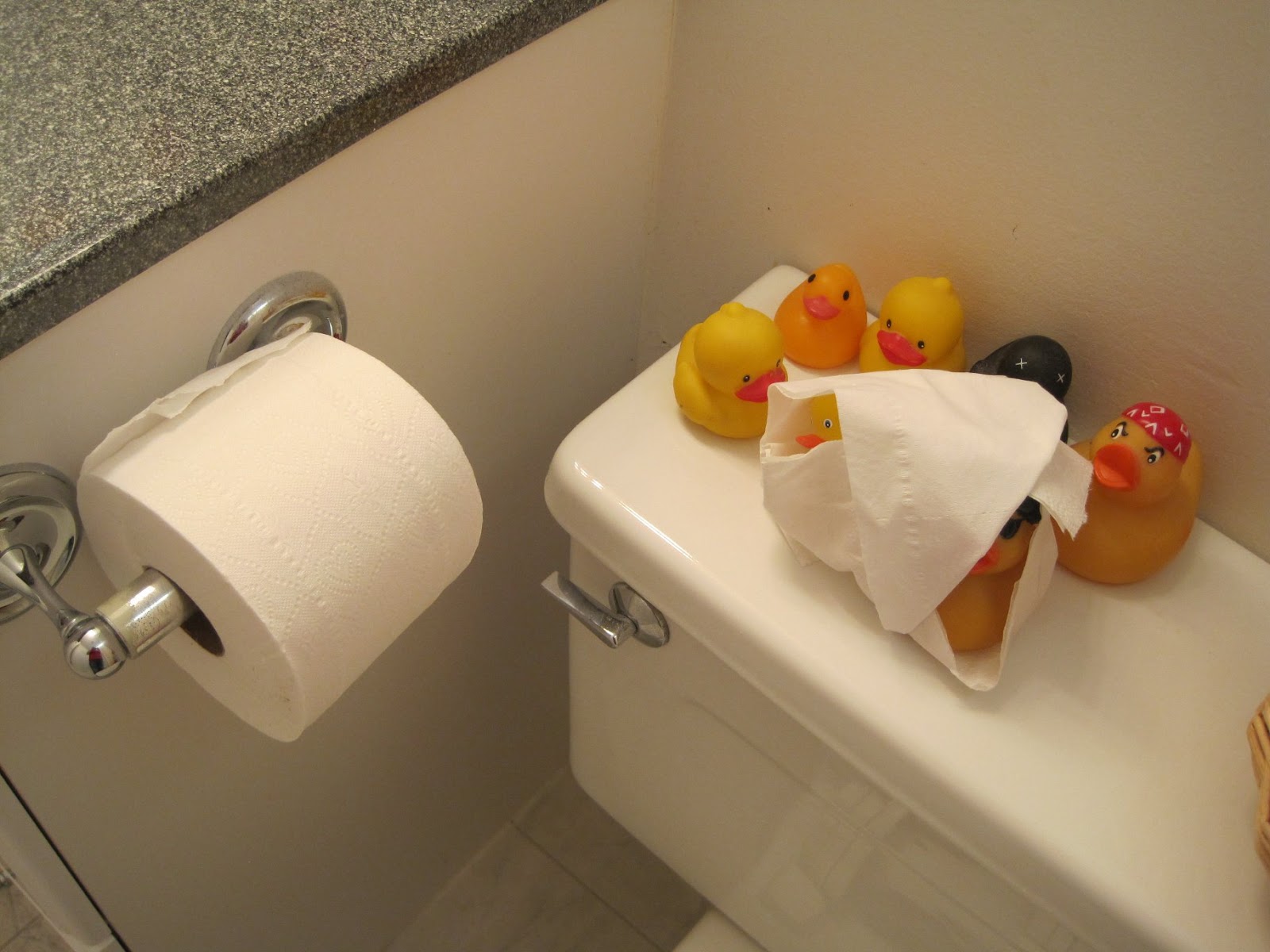
...turn to the task at hand. (Please ignore the ducks. They've invaded our bathroom and nothing we can do will dissuade them from hanging out atop the toilet tank.)

The bar across the center of this TP dispenser is spring-loaded. With boldness, grasp one end of the bar (it doesn't really matter which one -- just pick a side)...

...push firmly toward the other end, and guide the bar down and out of the brackets.

Assuming the spring-loaded bar didn't make a break for freedom and leap toward the floor, you now have a bar with an empty TP roll on it.

As the ducks look on in wonder, grab the empty roll and slide it off the bar. Houston, we have separation.

Once the empty roll is off, feel free to recycle it, craft it into some treasure of trash, or just fling it in the bin with utter insouciance. (Live for the moment, I say!)

Now pick up your trusty new roll of toilet paper...

... and slide the bar right through the handy-dandy hole in the middle.

The never-ending jihad known as Over or Under will not be discussed here. You figure out what works for your household and leave me out of it, OK?

Now you're going to perform a reverse version of the maneuver you used to get the bar off: fit one side of the bar into one bracket...

... press the bar in until it compresses a little...

... and guide the other end of the bar into the other bracket.

Mission accomplished! You now have a working roll of toilet paper, ready to go.

What you choose to do with it next is up to you.

Tuesday, May 28, 2013

How to help a grieving friend

Snark-lovers, be forewarned: for obvious reasons, this one isn't going to be funny.

All right, you're young and strong and even if you don't admit it, you may secretly believe you're invincible. But all that changes abruptly when someone close to you dies. Someone you saw all the time, someone you cared about, someone whose presence you probably took for granted is gone, and you will never see that person again in your life. Not only do you miss that person terribly, but you realize that if he or she died, then so can you. Suddenly your own mortality becomes very real. This may be the reason why so many people try to avoid someone who's grieving -- they're trying to evade the unsettling reminder that someday they, too, will die.

In the West our attitudes toward aging and death have grown increasingly unhealthy; we try to hide from death, box it up, pretend it doesn't exist. But death is a part of life. It can't be evaded, and frankly it shouldn't be. Yes, going through grief is indescribably painful. Yes, it's frightening to contemplate your own death and what may or may not lie beyond it. But it's healthier to face up to the pain and fear, to let yourself feel them, to walk through them, to accept them for what they are, and eventually to come out the other side. As with many other bogeymen, death can only hurt you with the tools you choose to give it.

With this in mind, what's the adult way to help a friend who is going through the aftereffects of a loved one's death? Well, everyone handles grief a little differently, so you'll need to adapt this list to individual circumstances, but these are a set of general guidelines.
  1. Listen. When someone dies, quite often a survivor wants to talk about it -- about shared memories of the deceased, about the circumstances surrounding the person's death, about what it's like to go through grief. Many people are uncomfortable hearing these things and will therefore avoid talking to the survivor, but providing a sympathetic, listening ear is one of the most compassionate things you can do for a grieving person. You shouldn't push the survivor to talk, but be comfortably open to conversation about the dead person -- don't shy away from mentioning him or her by name, or talking about things he or she liked to do.
  2. Be prepared for unpredictable emotional responses. Grieving people can be laughing one moment and crying the next; they can be numb or stoic for days at a time and then suddenly begin raging against the unfairness of a cruel world. Remember that these sudden storms of emotion are not to be taken too personally. Life after a loved one's death is like navigating an emotional minefield. You may think you're moving along just fine, and then a passing thought, a word or phrase, a particular scent or visual will trigger a memory that devastates you all over again. Expect these responses. Although they may seem unreasonable, they are a normal part of grief, and over time they will decrease in frequency and intensity.
  3. Bring food. Grief is a physical phenomenon as well as an emotional one. Survivors often feel dizzy, disoriented, physically cold and shaky, especially in the first few days after a death. They often remember events out of sequence, and may have trouble sleeping or eating. If you ask them whether they're hungry, they will often say "no" even if they really need to eat. So don't ask. Bring over something easy to digest, such as soup, ice cream, smoothies or gelatin, and hand them a serving. No need to force it on them; they will probably take a spoonful or a sip just to be polite, and often that's enough to stimulate the hunger response. A week or two later, if you wish, you may inquire about bringing over a more substantial meal -- comfort food is a good choice.
  4. Decide what you can do to help out. Survivors are often physically and mentally exhausted after a death, and have a difficult time making even simple decisions. Asking some variation of "Is there anything I can do?" isn't useful, as the survivor is usually unable to focus on the question and formulate an answer. Instead, make a short list of things you're willing to do, go to the survivor and present it like this: "I can drive you places, I can pick up groceries, I can take care of your bills, or I can watch your children. Which one would be most helpful right now?" When it comes to answering questions, multiple choice is always easier than essay. Then once the survivor has made a choice from your list, follow it up by doing what you offered to do. (This shouldn't have to be said, but I'm saying it anyway.)
  5. When possible and appropriate, offer financial help. This is sensitive territory, and it must be handled sensitively. In cases where the deceased was the primary breadwinner and there were no contingency plans in place such as a will or insurance, the survivor(s) can fall into financial trouble very quickly. But often a survivor is not comfortable asking others for money, due to a desire for self-sufficiency or simply an all-consuming exhaustion. You needn't wait for someone to ask, though. You can send money anonymously if you have the means, or take up a collection for the survivor(s) through a crowdfunding site. But before you do so, please take into account the feelings, needs and desires of the survivor. And don't use money as a substitute for engaging.
  6. Please, please, please, think before you speak. Sometimes people are so keen to have something to say to the bereaved that they put their feet in their mouths. Don't tell the survivor how hard this is for you -- share that sentiment with a friend further distanced from the tragedy. And even if you believe it, DO NOT tell survivors that the death was God's will, or that God must have needed the dead person. It's not comforting, and can actually create long-lasting psychological pain. My sister still has not made her peace with a God who she believes took her father away, because when she was a small child some well-meaning idiot suggested to her that God needed her daddy in heaven more than his wife and six small children needed him on earth. It's better to keep your comments simple. "I'm so sorry for your loss" and a gentle hug, if appropriate, are sufficient.
  7. Help the survivor find something to look forward to. One of the things my mother has often said about my dad's death is that, concurrently with her grief over his passing, she grieved over the death of so many of their shared goals and dreams -- the things they planned to do together. Many survivors, especially in the first few months after a loved one's death, have a tough time finding reasons to keep living. You can't just drag them here and there, but if you find activities you think they might enjoy, tell them. Sign up for adventures and invite them to come with you. Have them accompany you to a new restaurant for lunch. Your job is not to set the survivor up with anybody -- frankly, that's nobody's business -- but to provide opportunities once in a while for the survivor to develop new interests in the next chapter of his or her life.
  8. Be patient. Grief isn't like getting the 24-hour flu. It takes time; how much time varies from person to person. You can't expect a survivor to bounce back right after the funeral, or in two weeks, or even in six months. Grief is a journey taken on foot through an unknown wilderness. You can provide oases of rest and support now and then, but you can't hurry people through the process; trying to push them to be done with it only delays the journey. Try to show the kind of grace, patience and love you would want others to show you if you were taking that same journey, and have faith that your friend will eventually reach a point where his or her life begins to get better.
If you truly seek to be something more than a fair-weather friend, you should do what you can to support your friends in hard times. It will be difficult and emotionally wrenching to do so. But true adults are brave enough to undergo potential pain for the sake of the people they love and care about, and in so doing, will grow stronger from helping to lift and lighten another person's burden of grief.

Monday, May 20, 2013

How to shop for groceries

I'll bet you think you already know how to shop for groceries.

Hmm.

OK, picture this: you enter the grocery store just after a long day at work or school, dying of hunger, and immediately have to cut your way through the starving barbarian hordes of workers and students who are doing exactly the same thing. Your impulsive monkey brain prompts you to grab lots of ready-to-eat food from the deli and bakery sections of the store. Then you run up and down the aisles, cavalierly tossing anything that looks good into your cart. Dead-ending in the produce section, you throw in some guilt-purchased bagged lettuce and a few other fruits and veggies that you have every intention of making into... something, eventually. You wait 20 minutes in line to pay an insane price for this cart fulla goodness, as all your frozen foods defrost. On the way home, since by now you're so hungry you're in danger of gnawing off your own arm for sustenance, you pick up some fast food for dinner. Three weeks later you have to hose out your fridge's crisper bin because it's full of rotting goop that was once the vegetables you bought.

This scenario happens to everyone once in a while, but if it describes most of your shopping trips? Yeeeeeaaaaah, you don't really know what you're doing. It's time you got schooled!

You will need:
  1. The most recent advertising circular from your grocery store of choice.
  2. Some time to figure out a plan of attack.
  3. Grocery money from your spending plan.
  4. A cookbook or a set of recipes you want to try.
  5. A piece of paper and a pen or pencil.
  6. A calculator (optional).
  7. Transportation to and from the grocery store.
Here's whatcha do.

Strategic planning


Strategic grocery shoppers can successfully manage three factors: how much money they have to spend, what's on sale, and what they want to cook.

Figure out first how much cash you have to work with; pull the amount from your spending plan and keep it in front of you as you work out your grocery list.

Now browse the ad circular. It will list all the items on sale this week. If you see a sale item you know you'll need (toilet paper, soap, toothpaste, etc.), write it down. It's also a good idea to write down the brand name and advertised price so you remember what's on sale when you're at the store. If the circular has any printed coupons for things you use, cut them out and take them with you. (Don't be too proud to use coupons! They'll save you money, and the store expects people to use them.)

Finally, look over the recipes you want to try. See any ingredients from the recipes that are on sale this week? It's a little like playing that old memory game where you try to find two matching images on the cards. Focus heavily on the recipes with items that are on sale, and write down what you'll need to make each recipe. Your grocery list is taking shape. As you go, make a rough estimate of the running total (you may need to use a calculator), so that you don't end up spending more money than you have.

Hungry? Eat a small, high-protein snack (examples: lunchmeat, fried egg, beef jerky, cheese stick, peanut butter) before you go shopping. Protein satisfies your hunger without making you feel stuffed, and when you go grocery shopping you want to aim for a happy medium -- not too hungry, not too full. (If you are too full, everything food-related will look nauseating, especially under those soul-sucking fluorescent lights. Wait an hour or two before you go shopping.)

Now gather up your money, grocery list and coupons and, to paraphrase a line from Predator, "Get to da shop-pah!"

In the store


If you can swing it, shop at a time of day when the store isn't packed fulla customers. I know circumstances don't always make this possible, but when the store is less hectic, you'll feel a lot less stressed and you'll make better choices. (Since I'm a night owl by nature and my local grocery is open 24 hours, I've become the master of the Epic Late-Night Grocery Run. Late-night shopping means there's food in the house first thing in the morning, and it also makes redeeming a whole stack of coupons less vexing to others, since I rarely have to worry about anyone waiting behind me in line.)

Plan a path through the grocery store. Start in the produce section, move to the canned foods, pantry and nonperishable items, non-foods (things like soap and TP), then baked goods, eggs and dairy, meat and seafood, and finish with the frozen items. If you buy the perishable and frozen items last, just before you hit checkout, they'll be in much better shape by the time you get home.

Don't just merrily fling stuff into your cart; pay attention to what you're buying. Check expiration dates on dairy products and canned goods, open and inspect cartons of eggs to make sure none are cracked or smashed, make sure produce isn't bruised or moldy, check the labels to find out what you're eating, and don't grab the first shopworn container off the shelf. You may as well get the most value for your money.

Buy head lettuce rather than bagged lettuce. It doesn't take that much extra time to prepare, and head lettuce is usually cheaper and lasts a lot longer than the stuff in the bag. And if you never buy anything but iceberg lettuce, try branching out a little and picking up some red leaf, Romaine, butter lettuce, arugula or spinach, depending on what's on sale.

Pick up fruits and vegetables when they're in season, and plan your recipes around them. They'll be cheaper and taste better. If you have no notion of what's in season, do a web search for "in-season produce" for your area -- or just let your nose be your guide; really fresh fruit tends to smell wonderful. And don't be scared of whole fruits and vegetables. They don't take much time to clean and prepare, and they cost less if you do the prep work yourself.

If something you need isn't on sale, look for a store brand. Many large grocery chains offer house-brand items that are as good as or better than the nationally-advertised brands, and they're almost always less expensive. Sometimes they're even less expensive than the advertised sale item. (If you're not sure you'll like the store brand, get the smallest available size of the item and sample it at home; if you hate it, most stores will let you return the unused portion for a refund.)

Check the Used Food Section for bargains. (No, I don't know of any stores that actually call their markdown areas "Used Food," but I'd love it if someone did.)  Meat, dairy and produce are usually marked down because they're close to expiring, so if you find a good deal here be prepared to use or freeze it ASAP. Marked-down bakery items are usually in danger of going stale (meh), but shouldn't actually be moldy (ew). Marked-down cans are usually dented; examine them very carefully to be sure there are no leaks, swelling or other signs that the contents have turned evil. Botulism poisoning is never a bargain.

Don't buy anything on display in the checkout line. Seriously. Pure impulse buys. STAY STRONG, LITTLE SHOPPER.

Don't forget your coupons -- and don't let your checker forget them. (I usually say, "By the way, I have some coupons" as the checker starts scanning my items, and I put them up on the check-writing platform so they're clearly visible. Then the checker scans my coupons and I smile delightedly as my grocery total starts to shrink.)

At home


Once you bring the bags in, put the frozen stuff away first, then the perishables, then the canned goods and pantry items, and finally the non-foods.

Plan out your meals so that the most perishable food gets used up first. If you bought fresh fish, you should eat it by the next day. Eat fresh poultry within 48 hours. Ground meat goes bad faster than steaks, chops and roasts. And have a specific purpose in mind for your fruits and vegetables. Cook and eat them promptly so they don't have time to evolve into a new lifeform and crawl out of the fridge on their own. Yeeze.

Grocery Fu: for advanced shoppers only


Mastered all of the above, and ready to level up? OK, here we go.

Buy staple pantry items and non-perishable items in bulk whenever they go on sale. To do this effectively, you need a good feel for what items are "staple pantry items" around your place. Staples are the long-storing foods you use most often to cook or bake, and they vary from household to household depending on your cooking style and dietary needs. (Your kitchen canisters may be labeled Flour, Sugar, Coffee and Tea, but you probably won't use them for those items if you're a celiac, a diabetic and a Mormon, right?) If you don't know what your staple items are, look over the recipes you cook most often. Seeing certain familiar ingredients again and again? Behold your staples!

If you have a freezer, you can stock up on some perishable items that freeze well. Roasts and chops freeze well if they're wrapped properly. So does butter (let it defrost in the fridge before using it). Milk? Ehh, notsamuch. If you plan to do a lot of freezing, check out this list of foods that freeze well (and some foods that don't).

Shop around. Many grocery stores have frequent buyer programs where they'll give you discounts on groceries and/or gasoline if you shop there more often, but it's easy to fall into the rut of buying all your food in the same place... don't do that! Remember, it's OK to cheat on your grocery store! Check to see what the competition is doing every now and then, and see what they're offering that your usual grocery store doesn't. This goes double for specialty stores like Trader Joe's or your friendly neighborhood spice emporium. They won't have the wide range of products your local supermarket has, but they do offer amazing stuff at (usually) low prices. And don't forget your local farmers' markets, where you can find super-fresh local produce and the kind of unusual fruits and veggies that most big commercial farms don't bother to grow.

Peg Bracken, of The I Hate To Cook Book fame, used to suggest bringing a small cookbook to the grocery store; then if you come across a snazzy unadvertised sale on something, you can look it up in the book's index, find a good recipe for it, and save yourself another trip by picking up the needed recipe ingredients. Of course, Ms. Bracken wrote this in the early 1960s, when Al Gore was still busy inventing the Internet. Why lug around a cookbook if you already have a smartphone? The power of the Net in the palm of your hand!

Have any additional advice to share about honing your grocery shopping skills? Drop me a line!

Thursday, May 9, 2013

What the world owes you

Nothing.


What, did I stutter?

That's right, the rest of the world doesn't owe you a blessed thing just because you exist.

I know this statement will dismay some of you. Maybe you were raised in a household where your parental units always made sure things went smoothly for you, and you haven't had to lift a finger for yourself. Conversely, maybe you were raised in a household where you had nothing and you watched other people get whatever they wanted served up on a silver platter, and you didn't understand why they had all the opportunities you didn't. Either way, you may have developed the belief that society should now take responsibility for you and provide for all your needs.

Wrongo.

See, here's the thing: the rest of the world doesn't give two flying toots about your needs. Most other people are too busy taking care of themselves and others in their care to bother their heads about you and your notions of what you deserve. Yes, you may find a few people who are willing to extend themselves to help you in short bursts of charitable giving -- but expecting a total stranger to care for you indefinitely when you are healthy, able-bodied, of relatively sound mind, and otherwise capable of doing it for yourself, is the dictionary definition of chutzpah.

You may think -- and you'd be correct -- that you are a unique human being, different from anyone who has ever come before or will ever come again, and that this quality makes you special. But this isn't reason enough for the world to owe you anything, any more than the world owes a thing to all those other billions of special snowflakes existing alongside you. What makes your needs more important than the needs of some unique and irreplaceable peasant in China or India? (By the way, "because I'm me and they're not" doesn't cut it as an argument.)

So, if the world doesn't care about your needs, how do you make your way through it? Well, if you want to be valued and successful in this world you must discover and offer people something they want -- in other words, figure out how to do or make something useful, entertaining, or both.

Figuring out how to do this usually takes a while, and requires hands-on experience. You have to start somewhere to get this experience, and that's why there are unpaid internships and minimum-wage jobs. If you're like most people, you'll start working at one of these, and you will hate it. Such jobs are designed to do two things: 1) teach you that a strong work ethic is essential to future success and 2) strongly motivate you to get the hell out of this sucky dead-end job and into a career better suited to your specific talents.

What do I mean by a strong work ethic? I mean more than just showing up on time and getting stuff done, although if you do only these two things you'll be better off than 75% of your co-workers. I also mean maintaining a clean and well-kept appearance, regardless of the nature of your job. I mean being honest and trustworthy. I mean looking for ways to make the job easier, better and/or more productive while working within given rules. And I also mean finding reasons to be grateful for the opportunities your job provides. (Really. Even the suckiest dead-end job can teach you valuable life skills -- including how to avoid sucky dead-end jobs in future. Think of it as a school where they pay you tuition to attend.) If you can master these attitudes and behaviors, you won't be stuck working jobs you hate for very long.

Some people discover their particular talents in college. Others get them through the vagaries of life experience. Still others seem to sit around waiting for a magical talent to come along and knock them on their cans. (Hint: this rarely works.) Regardless of when it happens, the best way to discover your talents is to try various experiences. You'll never know whether you were meant to be the world's premiere yodeling bongo drummer if you've never learned how to yodel or play the bongos. If neither of these turns out to be your talent (and for the sake of everyone's ears, let's hope they're not), shrug and try something else. You're out to discover!

Assuming you keep trying, you will eventually find something for which you have a little spark of genius. (Woot.) Of course, one spark alone isn't going to carry you through life. Hone it, feed it, grow it, improve on it. Take classes, practice and experiment. (Think I was born writing snarky advice? Au contraire! I had to work at becoming this obnoxious.) As you do, be on the lookout for ways to merge your particular genius with making a living. Yes, of course you're going to exploit your talent -- why wouldn't you? Money is a representation of your life energy, so from a common-sense standpoint you might as well be making it from the thing(s) you do best.

Once you're making a living from the thing you were born to do, you will find you're a great deal happier, more satisfied with life and less anxious than you were when you were constantly tugging at the hems of an ill-fitting job. And if you do well enough that you're making more money than necessary to cover your needs and some of your wants (remember, by nature humans are little wanting machines, so you can't have everything), it's time to consider your answer to the Ultimate Boss Fight question of life: How am I going to leave this place better than I found it?

There's more than one way to answer this question. The Gateses are bringing the medical miracle of disease vaccination to the rest of the world. Paul Newman started a summer camp for seriously ill children. John D. Rockefeller founded a university. If you believe in God, you may see financial success as a kind of divine message -- as though God is reaching out His hand to you and saying, "Good for you. Now, how'd you like to help bless other people?" Andrew Carnegie called this message "the Gospel of Wealth." He believed in the importance of literacy for everyone, and chose to give away his fortune to establish thousands of American libraries.

By naming wealthy and well-known philanthropists, I'm not suggesting you must be Uncle Pennybags before you can improve the world. Priests, nuns, monks and others who have taken vows of poverty have been able to improve the world in dramatic ways, simply by contributing their time in service to others. If you have a mere $1 to spare after working out your spending plan, you can put that smidgen of cash toward something -- even if it's just a can of vegetables to take to your local food bank. And if you have as little as an hour of free time, countless charitable organizations would love to have you volunteer.

No, the world doesn't owe you a thing. But if you first learn to take care of yourself and then reach out to help care for others, the world will be forever in your debt. Not a bad fate, if you ask me.

Wednesday, April 24, 2013

Why 90 percent of self-help is useless

Wow. There's a title with some chutzpah. Here I am, writing what is essentially a self-help blog about becoming a real adult, and I've just asserted that most self-help doesn't do any good. Where do I get off saying that? And what, if anything, makes this blog different?

Let's take those questions one at a time, shall we?

I'm hardly the first person to notice -- nor will I be the last -- that self-help has become a huge and very lucrative industry. Considering the vast quantities of self-help books, movies, blogs (ehem), magazines, seminars, etc. at our disposal, every living person on earth ought to be an expert at everything by now. Yet people continue to buy books, attend seminars and pick up self-hypnosis kits with one goal in mind: shedding their personal insecurities and becoming better than they are today. It's almost as though some people are addicted to the idea of self-improvement.

The question is, after shooting up their self-help fix, do these people actually see any improvement in themselves?

David Wong of Cracked.com has written a clever (if somewhat profane) article that cuts to the heart of this problem: How 'The Karate Kid' Ruined The Modern World. Way too many of us think of skills to be mastered as though they were a 30-second training montage from an action film. In real life, the effort you must expend to master a skill is measured in months or years -- but in entertainment it's always edited down to a quick montage because, hey, watching people practice stuff is boring. Yet the brevity of these montages subtly encourages us to think we can become experts in less time than it takes to talk about it -- and later, we curl up and wail like infants when we find out that gaining expertise in a discipline requires a much bigger investment of time and effort.

We tend to read self-help books with the unconscious belief that reading is all that's required for us to enjoy the promised success, rather than actually getting off our duffs and doing what the books say to do. Worse, many of the people who write self-help materials deliberately exploit this widespread belief that success is effortless. (Think about titles like The 4-Hour Workweek, Think and Grow Rich, and 59 Seconds: Think A Little, Change A Lot. They all point to the idea that personal change is easy and fast.) Even the media hop on board, perpetuating myths such as the "overnight success" of a suddenly-popular artist or band (ignoring the years of toiling in obscurity that an artist or band endured before making it big) or the idea that "natural talents" like Mozart emerged from the womb ready to write The Marriage of Figaro (hint: he didn't).

Here's a simple rule of thumb regarding success. If someone is making wheelbarrow-loads of cash doing something, you can pretty much count on one or both of these being true:
  1. It required a combination of significant time, effort and talent to get there.
  2. Something illegal is going on.
If Academy Award-level acting were easy, everyone would have an Oscar gathering dust on the mantelpiece. If it were trivially simple to learn speed skating or ice dancing, you'd see Winter Olympics medals being donated to Goodwill. And if everyone had what it took to become a neurosurgeon, brain surgeries would be a whole lot cheaper. Since you don't see these things, it's safe to assume that certain very lucrative activities require a certain base level of talent combined with a whopping crapload of effort, consistently applied over a very long time.

OK, so you get it. It's not enough to know your stuff. Reading self-help books doesn't make you successful, any more than smelling shampoo will give you clean hair.  The point is, no amount of reading is going to do you any good unless you actually get up and DO. IT.

So why is this blog different from other self-help?

Well, for one thing, because I'm telling you outright: The stuff I'm teaching you isn't always easy, and it isn't always fast.  It also requires more than just passive reading -- it requires consistent activity.  In other words, don't just read this blog for pleasure, GET OFF YOUR LAZY BUTT AND DO THIS STUFF.

When I write an entry on this blog -- say, an article on the basics of personal hygiene -- here's the behavior I expect from you, the reader:
  1. Read carefully. Smile at the snark, if it pleases you (and I hope it does).
  2. Review the points of the article to make sure you remember what you read.
  3. ACTUALLY TAKE A FREAKING BATH.
That's it. In this case, it's literally lather, rinse, repeat until you've mastered the art of bathing.

Look, I don't expect you to master all this stuff next week. Becoming an adult does take time and work. But I do expect you to pick an article, read it, and PRACTICE THE STEPS until the skill becomes second nature to you. It may be hard at first, but it does get easier with practice -- so although I'm not going to tell you it's easy, I can definitely tell you that it's worth the effort.

Otherwise, if you don't bother to do anything with the information you learn here, this blog becomes part of the useless 90 percent of self-help materials, rather than the 10 percent that actually helps people effect change for the better.

But remember this: only your efforts determine which materials make up that useful 10 percent for you.

Act wisely, won't you?